MEAT, POULTRY, AND GAME SOUPS.
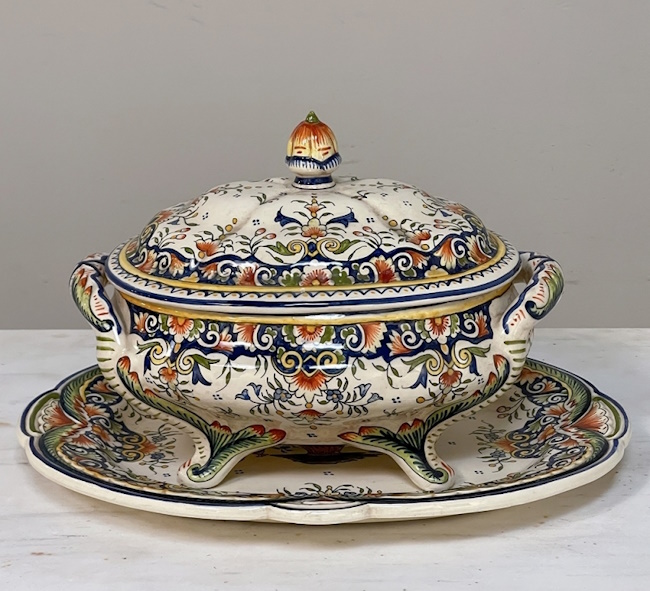
19th Century French Faience Hand-Painted Soup Tureen with Platter
Picture :
Inessa Stewart's Antiques ~ Baton Rouge
166. BRILLA SOUP.
4 lbs. of shin of beef,
3 carrots,
2 turnips,
a large sprig of thyme,
2 onions,
1 head of celery,
salt and pepper to taste,
4 quarts *) ≈ 4 l. water.
Mode. — Take the beef, cut off all the meat from the bone, in nice square pieces, and boil the bone for 4 hours. Strain the liquor, let it cool, and take off the fat; then put the pieces of meat in the cold
liquor; cut small the carrots, turnips, and celery; chop the onions, add them with the thyme and seasoning, and simmer till the meat is tender. If not brown enough, colour it with browning.
Time. — 6 hours.
Average cost, 5d. per quart.
Seasonable all the year.
Sufficient for 10 persons.
THYME. — This sweet herb was known to the Romans, who made use of it in culinary preparations, as well as in aromatic liqueurs. There are two species of it growing wild in Britain, but the garden thyme is a native of the south of Europe, and is more delicate in its perfume than the others. Its young leaves give an agreeable flavour to soups and sauces; they are also used in stuffings.
167. CALF'S-HEAD SOUP.
½ a calf's head,
1 onion stuck with cloves,
a very small bunch of sweet herbs,
2 blades of mace,
salt and white pepper to taste,
6 oz. *) ≈ 175 g. of rice-flour,
3 tablespoonfuls of ketchup,
3 quarts *) ≈ 3 l. of white stock,
No. 107, or pot-liquor, or water.
Mode. — Rub the head with salt, soak it for 6 hours, and clean it thoroughly; put it in the stewpan, and cover it with the stock, or pot-liquor, or water, adding the onion and sweet herbs. When well skimmed and boiled for 1½ hour, take out the head, and skim and strain the soup. Mix the rice-flour with the ketchup, thicken the soup with it, and simmer for 5 minutes. Now cut up the head into pieces about two inches long, and simmer them in the soup till the meat and fat are quite tender. Season with white pepper and mace finely pounded, and serve very hot. When the calf's head is taken out of the soup, cover it up, or it will discolour.
Time. — 2½ hours.
Average cost,1s. 9d. per quart, with stock No. 107.
Seasonable from May to October.
Sufficient for 10 persons.
Note. — Force-meat balls can be added, and the soup may be flavoured with a little lemon-juice, or a glass of sherry or Madeira. The bones from the head may be stewed down again, with a few fresh vegetables, and it will make a very good common stock.
168. GIBLET SOUP.
3 sets of goose or duck giblets,
2 lbs. *) ≈ 1 kg. of shin of beef,
a few bones,
1 ox-tail,
2 mutton-shanks,
2 large onions,
2 carrots,
1 large faggot of herbs,
salt and pepper to taste,
¼ pint *) ≈ 1/8 l. of cream,
1 oz. *) ≈ 30 g. of butter mixed with a dessert-spoonful of flour,
3 quarts *) ≈ 3 l. of water.
Mode. — Scald the giblets, cut the gizzards in 8 pieces, and put them in a stewpan with the beef, bones, ox-tail, mutton-shanks, onions, herbs, pepper, and salt; add the 3 quarts of water, and simmer till the giblets are tender, taking care to skim well. When the giblets are done, take them out, put them in your tureen, strain the soup through a sieve, add the cream and butter, mixed with a dessert-spoonful of flour, boil it up a few minutes, and pour it over the giblets. It can be flavoured with port wine and a little mushroom ketchup, instead of cream. Add salt to taste.
Time. — 3 hours.
Average cost,9d. per quart.
Seasonable all the year.
Sufficient for 10 persons.
169. GRAVY SOUP.
6 lbs. *) ≈ 3 kg. of shin of beef,
a knuckle of veal weighing 5 lbs. *) ≈ 2½ kg.,
a few pieces or trimmings,
2 slices of nicely-flavoured lean, ham;
¼ lb. *) ≈ 125 g. of butter,
2 onions,
2 carrots,
1 turnip,
nearly a head of celery,
1 blade of mace,
6 cloves,
a hunch of savoury herb with endive,
seasoning of salt and pepper to taste,
3 lumps of sugar,
5 quarts *) ≈ 5 l. of boiling soft water. It can be flavoured with ketchup, Leamington sauce
, Harvey's sauce,
and a little soy.
Mode. — Slightly brown the meat and ham in the butter, but do not let them burn. When this is done, pour to it the water, and as the scum rises, take it off; when no more appears, add all the other ingredients, and let the soup simmer slowly by the fire for 6 hours without stirring it any more from the bottom; take it off, and let it settle; skim off all the fat you can, and pass it through a tammy. When perfectly cold, you can remove all the fat, and leave the sediment untouched, which serves very nicely for thick gravies, hashes, &c.
Time. — 7 hours.
Average cost, 1s. per quart.
Seasonable all the year.
Sufficient for 14 persons.
 ENDIVE. — This plant belongs to the acetarious tribe of vegetables, and is supposed to have originally come from China and Japan. It was known to the ancients; but was not introduced to England till about the middle of the 16th century. It is consumed in large quantities by the French, and in London, — in the neighbourhood of which it is grown in abundance; — it is greatly used as a winter salad, as well as in soups and stews.
170. HARE SOUP. I.
A hare fresh-killed,
1 lb. *) ≈ ½ kg. of lean gravy-beef,
a slice of ham,
1 carrot,
2 onions,
a faggot of savoury herbs,
¼ oz. *) ≈ 7 g. of whole black pepper,
a little browned flour,
¼ pint *) ≈ 1/8 l. of port wine,
the crumb of two French rolls,
salt and cayenne to taste,
3 quarts *) ≈ 3 l. of water.
Mode. — Skin and paunch the hare, saving the liver and as much blood as possible. Cut it in pieces, and put it in a stewpan with all the ingredients, and simmer gently for 8 hours. This soup should be made the day before it is wanted. Strain through a sieve, put the best parts of the hare in the soup, and serve.
170a. HARE SOUP II.
Proceed as above; but, instead of putting the joints of the hare in the soup, pick the meat from the bones, pound it in a mortar, and add it, with the crumb of two French rolls, to the soup. Rub all through a sieve; heat slowly, but do not let it boil. Send it to table
immediately.
Time.-8 hours.
Average cost, 1s. 9d. per quart.
Seasonable from September to February.
Sufficient for 10 persons.
 THE COMMON HARE. — This little animal is found throughout Europe, and, indeed, in most of the northern parts of the world; and as it is destitute of natural weapons of defence, Providence has endowed it with an extraordinary amount of the passion of fear. As if to awaken the vigilance of this passion, too, He has furnished it with long and tubular ears, in order that it may catch the remotest sounds; and with full, prominent eyes, which enable it to see, at one and the same time, both before and behind it. The hare feeds in the evenings, and sleeps, in its form, during the day; and, as it generally lies on the ground, its feet, both below and above, are protected with a thick covering of hair. Its flesh, though esteemed by the Romans, was forbidden by the Druids and by the earlier Britons. It is now, though very dark and dry, and devoid of fat, much esteemed by Europeans, on account of the peculiarity of its flavour. In purchasing this animal, it ought to be remembered that both hares and rabbits, when old, have their claws rugged and blunt, their haunches thick, and their ears dry and tough. The ears of a young hare easily tear, and it has a narrow cleft in the lip; whilst its claws are both smooth and sharp.
171. HESSIAN SOUP.
Half an ox's head,
1 pint of split peas,
3 carrots,
6 turnips,
6 potatoes,
6 onions,
1 head of celery,
1 bunch of savoury herbs,
pepper and salt to taste,
2 blades of mace,
a little allspice,
4 cloves,
the crumb of a French roll,
6 quarts *) ≈ 6 l. of water.
Mode. — Clean the head, rub it with salt and water, and soak it for 5 hours in warm water. Simmer it in the water till tender, put it into a pan and let it cool; skim off all the fat; take out the head, and add the vegetables cut up small, and the peas which have been previously soaked; simmer them without the meat, till they are done enough to pulp through a sieve. Add the seasoning, with pieces of the meat cut up; give one boil, and serve.
Time. — 4 hours.
Average cost, 6d. per quart.
Seasonable in winter.
Sufficient for 16 persons.
Note. — An excellent hash or ragoût can be made by cutting up the nicest parts of the head, thickening and seasoning more highly a little of the soup, and adding a glass of port wine and 2 tablespoonfuls of ketchup.
172. MOCK TURTLE I.
½ a calf's head,
¼ lb. *) ≈ 125 g. of butter,
¼ lb. *) ≈ 125 g. of lean ham,
2 tablespoonfuls of minced parsley,
a little minced lemon thyme, sweet marjoram, basil,
2 onions,
a few chopped mushrooms (when obtainable),
2 shallots,
2 tablespoonfuls of flour,
¼ bottle of Madeira or sherry,
force-meat balls,
cayenne, salt and mace to taste,
the juice of 1 lemon and 1 Seville orange,
1 dessert-spoonful of pounded sugar,
3 quarts *) ≈ 3 l. of best stock, No. 104.
Mode. — Scald the head with the skin on, remove the brain, tie the head up in a cloth, and let it boil for 1 hour. Then take the meat from the bones, cut it into small square pieces, and throw them into cold water. Now take the meat, put it into a stewpan, and cover with stock; let it boil gently for an hour, or rather more, if not quite tender, and set it on one side. Melt the butter in another stewpan, and add the ham, cut
small, with the herbs, parsley, onions, shallots, mushrooms, and nearly a pint of stock; let these simmer slowly for 2 hours, and then dredge in as much flour as will dry up the butter. Fill up with the remainder of the stock, add the wine, let it stew gently for 10 minutes, rub it through a tammy, and put it to the calf's head; season with cayenne, and, if required, a little salt; add the juice of the orange and lemon; and when liked, ¼ teaspoonful of pounded mace, and the sugar. Put in the force-meat balls, simmer 5 minutes, and serve very hot.
Time. — 4½ hours.
Average cost, 3s. 6d. per quart, or 2s. 6d.
without wine or force-meat balls.
Seasonable in winter.
Sufficient for 10 persons.
Note. — The bones of the head should be well stewed in the liquor it was first boiled in, and will make good white stock, flavoured with vegetables, etc.
173. MOCK TURTLE II.(
More Economical.)
A knuckle of veal weighing 5 or 6 lbs. *) ≈ 2½ - 3 kg.,
2 cow-heels,
2 large onions stuck with cloves,
1 bunch of sweet herbs,
3 blades of mace,
salt to taste,
12 peppercorns,
1 glass of sherry,
24 force-meat balls,
a little lemon-juice,
4 quarts *) ≈ 4 l. of water.
Mode. — Put all the ingredients, except the force-meat balls and lemon-juice, in an earthen jar, and stew for 6 hours. Do not open it till cold. When wanted for use, skim off all the fat, and strain carefully; place it on the fire, cut up the meat into inch-and-a-half squares, put it, with the force-meat balls and lemon-juice, into the soup, and serve. It can be flavoured with a tablespoonful of anchovy, or Harvey's sauce.
Time. — 6 hours.
Average cost,1s. 4d. per quart.
Seasonable in winter.
Sufficient for 10 persons.
THE CALF — The flesh of this animal is called veal, and when young, that is, under two months old, yields a large quantity of soluble extract, and is, therefore, much employed for soups and broths. The Essex farmers have obtained a celebrity for fattening calves better than any others in England, where they are plentifully supplied with milk, a thing impossible to be done in the immediate neighbourhood of London.
MARJORAM. — There are several species of this plant; but that which is preferred for cookery is a native of Portugal, and is called sweet or knotted marjoram. When its leaves are dried, they have an agreeable aromatic flavour; and hence are used for
soups, stuffings, &c.
BASIL. — This is a native of the East Indies, and is highly aromatic, having a perfume greatly resembling that of cloves. It is not much employed in English cookery, but is a favourite with French cooks, by whom its leaves are used in soups and salads.
174. MULLAGATAWNY SOUP.
2 tablespoonfuls of curry powder,
6 onions,
1 clove of garlic,
1 oz. of pounded almonds,
a little lemon-pickle, or mango-juice, to taste;
1 fowl or rabbit,
4 slices of lean bacon;
2 quarts *) ≈ 2 l. of medium stock, or, if wanted very good, best stock.
Mode. — Slice and fry the onions of a nice colour; line the stewpan with the bacon; cut up the rabbit or fowl into small joints, and slightly brown them; put in the fried onions, the garlic, and stock, and simmer gently till the meat is tender; skim very carefully, and when the meat is done, rub the curry powder to a smooth batter; add it to the soup with the almonds, which must be first pounded with a little of the stock. Put in seasoning and lemon-pickle or mango-juice to taste, and serve boiled rice with it.
Time. — 2 hours.
Average cost, 1s. 6d. per quart, with stock
No. 105
Seasonable in winter.
Sufficient for 8 persons.
Note. — This soup can also be made with breast of veal, or calf's head. Vegetable Mullagatawny is made with veal stock, by boiling and pulping chopped vegetable marrow, cucumbers, onions, and tomatoes, and seasoning with curry powder and cayenne. Nice pieces of meat, good curry powder, and strong stock, are necessary to make this soup good.
 CORIANDER. — This plant, which largely enters into the composition of curry powder with turmeric, originally comes from the East; but it has long been cultivated in England, especially in Essex, where it is reared for the use of confectioners and druggists. In private gardens, it is cultivated for the sake of its tender leaves, which are highly aromatic, and are employed in soups and salads. Its seeds are used in large quantities for the purposes of distillation.
175. A GOOD MUTTON SOUP.
A neck of mutton about 5 or 6 lbs. *) ≈2½ - 3 kg.,
3 carrots,
3 turnips,
2 onions,
a large bunch of sweet herbs, including parsley;
salt and pepper to taste;
a little sherry, if liked;
3 quarts *) ≈ 3 l. of water.
Mode. — Lay the ingredients in a covered pan before the fire, and let them remain there the whole day, stirring occasionally. The next day put the whole into a stewpan, and place it on a brisk fire. When it commences to boil, take the pan off the fire, and put it on one side to simmer until the meat is done. When ready for use, take out the meat, dish it up with carrots and turnips, and send it to table; strain the soup, let it cool, skim off all the fat, season and thicken it with a tablespoonful, or rather more, of arrowroot; flavour with a little sherry, simmer for 5 minutes, and serve.
Time. — 15 hours.
Average cost, including the meat, 1s. 3d. per
quart.
Seasonable at any time.
Sufficient for 8 persons.
THE SHEEP. — This animal formed the principal riches of the patriarchs, in the days of old, and, no doubt, multiplied, until its species were spread over the greater part of Western Asia; but at what period it was introduced to Britain is not known. It is now found in almost every part of the globe, although, as a domestic animal, it depends almost entirely upon man for its support. Its value, however, amply repays him for whatever care and kindness he may bestow upon it; for, like the ox, there is scarcely a part of it that he cannot convert to some useful purpose. The fleece, which serves it for a covering, is appropriated by man, to serve the same end to himself, whilst its skin is also applied to various purposes in civilized life.
Its entrails are used as strings for musical instruments, and its bones are calcined, and employed as tests in the trade of the refiner. Its milk, being thicker than that of the cow, yields a greater quantity of butter and cheese, and its flesh is among the most wholesome and nutritive that can be eaten. Thomson has beautifully described the appearance of the sheep, when bound to undergo the operation of being shorn of its wool.
"Behold, where bound, and of its robe bereft
By needy man, that all-depending lord,
How meek, how patient, the mild creature lies!
What softness in his melancholy face,
What dumb complaining innocence appears!"
176.OX-CHEEK SOUP.
An ox-cheek,
2 oz. *) ≈ 50+ g. of butter,
3 or 4 slices of lean ham or bacon,
1 parsnip,
3 carrots,
2 onions,
3 heads of celery,
3 blades of mace,
4 cloves,
a faggot of savoury herbs,
1 bay-leaf,
a teaspoonful of salt,
half that of pepper,
1 head of celery,
browning,
the crust of a French roll,
6 quarts *) ≈ 6 l. of water.
Mode. — Lay the ham in the bottom of the stewpan, with the butter; break the bones of the cheek, wash it clean, and put it on the ham. Cut the vegetables small, add them to the other ingredients, and set the whole over a slow fire for ¼ of an hour. Now put in the water, and simmer gently till it is reduced to 4 quarts; take out the fleshy part of the cheek, and strain the soup into a clean stewpan; thicken with flour, put in a head of sliced celery, and simmer till the celery is tender. If not a good colour, use a little browning. Cut the meat into small square pieces, pour the soup over, and serve with the crust of a French roll in the tureen. A glass of sherry much improves this soup.
Time. — 3 to 4 hours.
Average cost, 8d. per quart.
Seasonable in winter.
Sufficient for 12 persons.
THE OX. — Of the quadrupedal animals, the flesh of those that feed upon herbs is the most wholesome and nutritious for human food. In the early ages, the ox was used as a religious sacrifice, and, in the eyes of the Egyptians was deemed so sacred as to be worthy of exaltation to represent Taurus, one of the twelve signs of the zodiac. To this day, the Hindoos venerate the cow, whose flesh is forbidden to be eaten, and whose fat, supposed to have been employed to grease the cartridges of the Indian army, was one of the proximate causes of the great Sepoy rebellion of 1857. There are no animals of greater use to man than the tribe to which the ox belongs. There is hardly a part of them that does not enter into some of the arts and purposes of civilized life. Of their horns are made combs, knife-handles, boxes, spoons, and drinking-cups. They are also made into transparent plates for lanterns; an invention ascribed, in England, to King Alfred. Glue is made from their gristles, cartilages, and portions of their hides. Their bones often form a substitute for ivory; their skins, when calves, are manufactured into vellum; their blood is the basis of Prussian blue; their sinews furnish fine and strong threads, used by saddlers; their hair enters into various manufactures; their tallow is made into candles; their flesh is eaten, and the utility of the milk and cream of the cow is well known.
177. OX-TAIL SOUP.
2 ox-tails,
2 slices of ham,
1 oz. *) ≈ 30 g. of butter,
2 carrots,
2 turnips,
3 onions,
1 leek,
1 head of celery,
1 bunch of savoury herbs,
1 bay-leaf,
12 whole peppercorns,
4 cloves,
a tablespoonful of salt,
2 tablespoonfuls of ketchup,
½ glass of portwine,
3 quarts *) ≈ 3 l. of water.
Mode. — Cut up the tails, separating them at the joints; wash them, and put them in a stewpan, with the butter. Cut the vegetables in slices, and add them, with the peppercorns and herbs. Put in ½ pint of water, and stir it over a sharp fire till the juices are drawn. Fill up the stewpan with the water, and, when boiling, add the salt. Skim well, and simmer very gently for 4 hours, or until the tails are tender. Take them out, skim and strain the soup, thicken with flour, and flavour with the ketchup and port wine. Put back the tails, simmer for 5 minutes, and serve.
Time. — 4½ hours.
Average cost, 1s. 3d. per quart.
Seasonable in winter.
Sufficient for 10 persons.
178. PARTRIDGE SOUP.
2 partridges,
3 slices of lean ham,
2 shred onions,
1 head of celery,
1 large carrot, and
1 turnip cut into any fanciful shapes,
1 small lump of sugar,
2 oz. *) ≈ 50+ g. of butter,
salt and pepper to taste,
2 quarts *) ≈ 2 l. of stock No. 105, or common, No. 106.
>Mode. — Cut the partridges into pieces, and braise them in the butter and ham until quite tender; then take out the legs, wings, and breast, and set them by. Keep the backs and other trimmings in the braise, and add the onions and celery; any remains of cold game can be put in, and 3 pints of stock. Simmer slowly for 1 hour, strain it, and skim the fat off as clean as possible; put in the pieces that were taken out, give it one boil, and skim again to have it quite clear, and add the sugar and seasoning. Now simmer the cut carrot and turnip in 1 pint of stock; when quite tender, put them to the partridges, and serve.
Time. — 2 hours.
Average cost, 2s. or 1s. 6d. per quart.
Seasonable from September to February.
Sufficient for 8 persons.
Note. — The meat of the partridges may be pounded with the crumb of a French roll, and worked with the soup through a sieve. Serve with stewed celery cut in slices, and put in the tureen.
THE PARTRIDGE. — This is a timorous bird, being easily taken. It became known to the Greeks and Romans, whose tables it helped to furnish with food. Formerly, the Red was scarce in Italy, but its place was supplied by the White, which, at considerable expense, was frequently procured from the Alps. The Athenians trained this bird for fighting, and Severus used to lighten the cares of royalty by witnessing the spirit of its combats. The Greeks esteemed its leg most highly, and rejected the other portions as unfashionable to be eaten. The Romans, however, ventured a little further, and ate the breast, whilst we consider the bird as wholly palatable. It is an inhabitant of all the temperate countries of Europe, but, on account of the geniality of the climate, it abounds most in the Ukraine.
179. PHEASANT SOUP.
2 pheasants,
¼ lb. *) ≈ 125 g. of butter,
2 slices of ham,
2 large onions sliced,
½ head of celery,
the crumb of two French rolls,
the yolks of 2 eggs boiled hard,
salt and cayenne to taste,
a little pounded mace, if liked;
3 quarts *) ≈ 3 l. of stock No. 105
Mode. — Cut up the pheasants, flour and braise them in the butter and ham till they are of a nice brown, but not burnt. Put them in a stewpan, with the onions, celery, and seasoning, and simmer for 2 hours. Strain the soup; pound the breasts with the crumb of the roll previously soaked, and the yolks of the eggs; put it to the soup, give one boil, and serve.
Time. — 2½ hours.
Average cost, 2s. 10d. per quart, or, if made
with fragments of gold game, 1s.
Seasonable from October to February.
Sufficient for 10 persons.
Note. — Fragments, pieces and bones of cold game, may be used to great advantage in this soup, and then 1 pheasant will suffice.
180. PORTABLE SOUP.
2 knuckles of veal,
3 shins of beef,
1 large faggot of herbs,
2 bay-leaves,
2 heads of celery,
3 onions,
3 carrots,
2 blades of mace,
6 cloves,
a teaspoonful of salt,
sufficient water to cover all the ingredients.
Mode. — Take the marrow from the bones; put all the ingredients in a stock-pot, and simmer slowly for 12 hours, or more, if the meat be not done to rags; strain it off, and put it in a very cool place; take off all the fat, reduce the liquor in a shallow pan, by setting it over a sharp fire, but be particular that it does not burn; boil it fast and uncovered for 8 hours, and keep it stirred. Put it into a deep dish, and set it by for a day. Have ready a stewpan of boiling water, place the dish in it, and keep it boiling; stir occasionally, and when the soup is thick and ropy, it is done. Form it into little cakes by pouring a small quantity on to the bottom of cups or basins; when cold, turn them out on a flannel to dry. Keep them from the air in tin canisters.
Average cost of this quantity, 16s.
Note. — Soup can be made in 5 minutes with this, by dissolving a small piece, about the size of a walnut, in a pint of warm water, and simmering for 2 minutes. Vermicelli, macaroni, or other Italian pastes,
may be added.
THE LAUREL or BAY. — The leaves of this tree frequently enter into the recipes of cookery; but they ought not to be used without the greatest caution, and not at all unless the cook is perfectly aware of their effects. It ought to be known, that there are two kinds of bay-trees, — the Classic laurel, whose leaves are comparatively harmless, and the Cherry-laurel, which is the one whose leaves are employed in cookery. They have a kernel-like flavour, and are used in blanc-mange, puddings, custards &c.; but when acted upon by water, they develop prussic acid, and, therefore, but a small number of the leaves should be used at a time.
181. RABBIT SOUP.
2 large rabbits, or 3 small ones;
a faggot of savoury herbs,
½ head of celery,
2 carrots,
1 onion,
1 blade of mace,
salt and white pepper to taste,
a little pounded mace,
½ pint *) ≈ 250 ml. of cream,
the yolks of 2 eggs boiled hard,
the crumb of a French roll,
nearly 3 quarts *) ≈ 3 l. of water.
Mode. — Make the soup with the legs and shoulders of the rabbit, and keep the nice pieces for a dish or entrée. Put them into warm water, and draw the blood; when quite clean, put them in a stewpan, with a faggot of herbs, and a teacupful, or rather more, of veal stock or water. Simmer slowly till done through, and add the 3 quarts of water, and boil for an hour. Take out the rabbet, pick the meat from the bones, covering it up to keep it white; put the bones back in the liquor, add the vegetables, and simmer for 2 hours; skim and strain, and let it cool. Now pound the meat in a mortar, with the yolks of the eggs, and the crumb of the roll previously soaked; rub it through a tammy, and gradually add it to the strained liquor, and simmer for 15 minutes. Mix arrowroot or rice-flour with the cream (say 2 dessert-spoonfuls), and stir in the soup; bring it to a boil, and serve. This soup must be very white, and instead of thickening it with arrowroot or rice-flour, vermicelli or pearl barley can be boiled in a little stock, and put in 5 minutes before serving.
Time. — Nearly 4 hours.
Average cost, 1s. per quart.
Seasonable from September to March.
Sufficient for 10 persons.
182. REGENCY SOUP.
Any bones and remains of any cold game, such as of pheasants, partridges, &c.;
2 carrots,
2 small onions,
1 head of celery,
1 turnip,
¼ lb. *) ≈ 125 g. of pearl barley,
the yolks of 3 eggs boiled hard,
¼ pint *) ≈ 125 ml. of cream,
salt to taste,
2 quarts *) ≈ 2 l. of stock No. 105, or common stock, No. 106
Mode. — Place the bones or remains of game in the stewpan, with the vegetables sliced; pour over the stock, and simmer for 2 hours; skim off all the fat, and strain it. Wash the barley, and boil it in 2 or 3 waters before putting it to the soup; finish simmering in the soup, and when the barley is done, take out half, and pound the other half with the yolks of the eggs. When you have finished pounding, rub it through a clean tammy, add the cream, and salt if necessary; give one boil, and serve very hot, putting in the barley that was taken out first.
Time. — 2½ hours.
Average cost, 1s. per quart, if made with medium
stock, or 6d. per quart, with common stock.
Seasonable from September to March.
Sufficient for 8 persons.
183. SOUP A LA REINE I.
1 large fowl,
1 oz. *) ≈ 30 g. of sweet almonds,
the crumb of 1½ French roll,
½ pint *) ≈ ¼ l. of cream,
salt to taste,
1 small lump of sugar,
2 quarts *) ≈ 2 l. of good white veal stock, No. 107
Mode. — Boil the fowl gently in the stock till quite tender, which will be in about an hour, or rather more; take out the fowl, pull the meat from the bones, and put it into a mortar with the almonds, and pound very fine. When beaten enough, put the meat back in the stock, with the crumb of the rolls, and let it simmer for an hour; rub it through a tammy, add the sugar, ½ pint of cream that has boiled, and, if you prefer, cut the crust of the roll into small round pieces, and pour the soup over it, when you serve.
Time. — 2 hours, or rather more.
Average cost, 2s. 7d. per quart.
Seasonable all the year.
Sufficient for 8 persons.
Note. — All white soups should be warmed in a vessel placed in another of boiling water. (See AU BAIN MARIE, No. 87.)
184. SOUP A LA REINE II. (Economical.)
Any remains of roast chickens,
½ teacupful of rice,
salt and pepper to taste,
1 quart *) ≈ 1 l. of stock No. 106.
Mode. — Take all the white meat and pound it with the rice, which has been slightly cooked, but not much. When it is all well pounded, dilute with the stock, and pass through a sieve. This soup should neither be too clear nor too thick.
Time. — 1 hour.
Average cost, 4d. per quart.
Seasonable all the year.
Sufficient for 4 persons.
Note. — If stock is not at hand, put the chicken-bones in water, with an onion, carrot, a few sweet herbs, a blade of mace, pepper and salt, and stew for 3 hours.
185. STEW SOUP OF SALT MEAT.
Any pieces of salt beef or pork, say 2 lbs. *)≈900g.;
4 carrots,
4 parsnips,
4 turnips,
4 potatoes,
1 cabbage,
2 oz. *) ≈ 60 g. of oatmeal or ground rice,
seasoning of salt and pepper,
2 quarts *) ≈ 2 l. of water.
Mode. — Cut up the meat small, add the water, and let it simmer for 2h.45' hours. Now add the vegetables, cut in thin small slices; season, and boil for 1 hour. Thicken with the oatmeal, and serve.
Time. — 2 hours.
Average cost, 3d. per quart without the meat.
Seasonable in winter.
Sufficient for 6 persons.
Note. — If rice is used instead of oatmeal, put it in with the vegetables.
186. STEW SOUP I.
2 lbs. *) ≈ 1 kg. of beef,
5 onions,
5 turnips,
¾ lb. *) ≈ 375 g. of rice,
a large bunch of parsley,
a few sweet herbs,
pepper and salt,
2 quarts *) ≈ 2 l. of water.
Mode. — Cut the beef up in small pieces, add the other ingredients, and boil gently for 2½ hours. Oatmeal or potatoes would be a great improvement.
Time.-2½ hours.
Average cost, 6d. per quart.
Seasonable in winter.
Sufficient for 6 persons.
187. STEW SOUP II.
½ lb. *) ≈ 250 g. of beef, mutton, or pork;
½ pint *) ≈ 250 ml. of split peas,
4 turnips,
8 potatoes,
2 onions,
2 oz. *) ≈ 60 g. of oatmeal or
3 oz. *) ≈ 200 g of rice,
2 quarts *) ≈ 2 l. of water.
Mode. — Cut the meat in small pieces, as also the vegetables, and add them, with the peas, to the water. Boil gently for 3 hours; thicken with the oatmeal, boil for another ¼ hour, stirring all the time, and season with pepper and salt.
Time. — 3¼ hours.
Average cost, 4d. per quart.
Seasonable in winter.
Sufficient for 8 persons.
Note. — This soup may be made of the liquor in which tripe has been boiled, by adding vegetables, seasoning, rice, &c.
188. TURKEY SOUP (a Seasonable Dish at Christmas).
2 quarts *) ≈ 2 l. of medium stock, No. 105,
the remains of a cold roast turkey,
2 oz. *) ≈ 60 g. of rice-flour or arrowroot,
salt and pepper to taste,
1 tablespoonful of Harvey's sauce or mushroom ketchup.
Mode. — Cut up the turkey in small pieces, and put it in the stock; let it simmer slowly until the bones are quite clean. Take the bones out, and work the soup through a sieve; when cool, skim well. Mix the rice-flour or arrowroot to a batter with a little of the soup; add it with the seasoning and sauce, or ketchup. Give one boil, and serve.
Time. — 4 hours.
Average cost, 10d. per quart.
Seasonable at Christmas.
Sufficient for 8 persons.
Note. — Instead of thickening this soup, vermicelli or macaroni may be
served in it.
THE TURKEY. — The common turkey is a native of North America, and was thence introduced to England, in the reign of Henry VIII. According to Tusser's "Five Hundred Points of Good Husbandry," about the year 1585 it begun to form a dish at our rural Christmas feasts.
"Beef, mutton, and pork, shred pies of the best,
Pig, veal, goose, and capon, and turkey well dress'd,
Cheese, apples, and nuts, jolly carols to hear,
As then in the country is counted good cheer."
It is one of the most difficult birds to rear, of any that we have; yet, in its wild state, is found in great abundance in the forests of Canada, where, it might have been imagined that the severity of the climate would be unfavourable to its ever becoming plentiful. They are very fond of the seeds of nettles,
and the seeds of the foxglove poison them.
189. TURTLE SOUP (founded on M. Ude's Recipe).
A turtle,
6 slices of ham,
2 knuckles of veal,
1 large bunch of sweet herbs,
3 bay-leaves, parsley,
green onions,
1 onion,
6 cloves,
4 blades of mace,
¼ lb. *) ≈ 125 g. of fresh butter,
1 bottle of Madeira,
1 lump of sugar.
For the Quenelles à Tortue,
1 lb. *) ≈ 450 g. of veal,
1 lb. *) ≈ 450 g. of bread crumbs,
milk,
7 eggs,
cayenne, salt, spices,
chopped parsley,
the juice of 2 lemons.
Mode. — To make this soup with less difficulty, cut off the head of the turtle the preceding day. In the morning open the turtle by leaning heavily with a knife on the shell of the animal's back, whilst you cut this off all round. Turn it upright on its end, that all the water, &c. may run out, when the flesh should be cut off along the spine, with the knife sloping towards the bones, for fear of touching the gall, which sometimes might escape the eye. When all the flesh about the members is obtained, wash these clean, and let them drain. Have ready, on the fire, a large vessel full of boiling water, into which put the shells; and when you perceive that they come easily off, take them out of the water, and prick them all, with those of the back, belly, fins, head, &c. Boil the back and belly till the bones can be taken off, without, however, allowing the softer parts to be sufficiently done, as they will be boiled again in the soup. When these latter come off easily, lay them on earthen dishes singly, for fear they should stick together, and put them to cool. Keep the liquor in which you have blanched the softer parts, and let the bones stew thoroughly in it, as this liquor must be used to
moisten all the sauces.
All the flesh of the interior parts, the four legs and head, must be drawn down in the following manner: — Lay the slices of ham on the bottom of a very large stewpan, over them the knuckles of veal, according to the size of the turtle; then the inside flesh of the turtle, and over the whole the members. Now moisten with the water in which you are boiling the shell, and draw it down thoroughly. It may now be ascertained if it be thoroughly done by thrusting a knife into the fleshy part of the meat. If no blood appears, it is time to moisten it again with the liquor in which the bones, &c. have been boiling. Put in a large bunch of all such sweet herbs as are used in the cooking of a turtle, — sweet basil, sweet marjoram, lemon thyme, winter savory, 2 or 3 bay-leaves, common thyme, a handful of parsley and green onions, and a large onion stuck with 6 cloves. Let the whole be thoroughly done. With respect to the members, probe them, to see whether they are done, and if so, drain and send them to the larder, as they are to make their appearance only when the soup is absolutely completed. When the flesh is also completely done, strain it through a silk sieve, and make a very thin white roux; for turtle soup must not be much thickened. When the flour is sufficiently done on a slow fire, and has a good colour, moisten it with the liquor, keeping it over the fire till it boils. Ascertain that the sauce is neither too thick nor too thin; then draw the stewpan on the side of the stove, to skim off the white scum, and all the fat and oil that rise to the surface of the sauce. By this time all the softer parts will be sufficiently cold; when they must be cut to about the size of one or two inches square, and thrown into the soup, which must now be left to simmer gently. When done, skim off all the fat and froth. Take all the leaves of the herbs from the stock, — sweet basil, sweet marjoram, lemon thyme, winter savory, 2 or 3 bay-leaves, common thyme, a handful of parsley and green onions, and a large onion cut in four pieces, with a few blades of mace. Put these in a stewpan, with about ¼ lb. of fresh butter, and let it simmer on a slow fire till quite melted, when pour in 1 bottle of good Madeira, adding a small bit of sugar, and let it boil gently for 1 hour. When done, rub it through a tammy, and add it to the soup. Let this boil, till no white scum rises; then take with a skimmer all the bits of turtle out of the sauce, and put them in a clean stewpan: when you have all out, pour the soup over the bits of turtle, through a tammy, and proceed as follows: —
QUENELLES À TORTUE. — Make some quenelles à tortue, which being substitutes for eggs, do not require to be very delicate. Take out the fleshy part of a leg of veal, about 1 lb., scrape off all the meat, without leaving any sinews or fat, and soak in milk about the same quantity of crumbs of bread. When the bread is well soaked, squeeze it, and put it into a mortar, with the veal, a small quantity of calf's udder, a little butter, the yolks of 4 eggs, boiled hard, a little cayenne pepper, salt, and spices, and pound the whole very fine; then thicken the mixture with 2 whole eggs, and the yolk of another. Next try this farce or stuffing in boiling-hot water, to ascertain its consistency: if it is too thin, add the yolk of an egg. When the farce is perfected, take half of it, and put into it some chopped parsley. Let the whole cool, in order to roll it of the size of the yolk of an egg; poach it in salt and boiling water, and when very hard, drain on a sieve, and put it into the turtle. Before you send up, squeeze the juice of 2 or 3 lemons, with a little cayenne pepper, and pour that into the soup. THE FINS may be served as a plat d'entrée with a little turtle sauce; if not, on the following day you may warm the turtle au bain marie, and serve the members entire, with a matelote sauce, garnished with mushrooms, cocks' combs, quenelles, &c. When either lemon-juice or cayenne pepper has been introduced, no boiling must take place.
Note. — It is necessary to observe, that the turtle prepared a day before it is used, is generally preferable, the flavour being more uniform. Be particular, when you dress a very large turtle, to preserve the green fat (be cautious not to study a very brown colour, — the natural green of the fish is preferred by every epicure and true connoisseur) in a separate stewpan, and likewise when the turtle is entirely done, to have as many tureens as you mean to serve each time. You cannot put the whole in a large vessel, for many reasons: first, it will be long in cooling; secondly, when you take some out, it will break all the rest into rags. If you warm in a bain marie, the turtle will always retain the same taste; but if you boil it often, it becomes strong, and loses the delicacy of its flavour.
THE COST OF TURTLE SOUP. — This is the most expensive soup brought to table. It is sold by the quart, — one guinea being the standard price for that quantity. The price of live turtle ranges from 8d. to 2s. per lb., according to supply and demand. When live turtle is dear, many cooks use the tinned turtle, which is killed when caught, and preserved by being put in hermetically-sealed canisters, and so sent over to England. The cost of a tin, containing 2 quarts, or 4 lbs., is about £2, and for a small one, containing the green fat, 7s. 6d. From these about 6 quarts of good soup may be made.
 THE GREEN TURTLE. — This reptile is found in large numbers on the coasts of all the islands and continents within the tropics, in both the old and new worlds. Their length is often five feet and upwards, and they range in weight from 50 to 500 or 600 lbs. As turtles find a constant supply of food on the coasts which they frequent, they are not of a quarrelsome disposition, as the submarine meadows in which they pasture, yield plenty for them all. Like other species of amphibia, too, they have the power of living many months without food; so that they live harmlessly and peaceably together, notwithstanding that they seem to have no common bond of association, but merely assemble in the same places as if entirely by accident. England is mostly supplied with them from the West Indies, whence they are brought alive and in tolerable health. The green turtle is highly prized on account of the delicious quality of its flesh, the fat of the upper and lower shields of the animal being esteemed the richest and most delicate parts. The soup, however, is apt to disagree with weak stomachs. As an article of luxury, the turtle has only come into fashion within the last 100 years, and some hundreds of tureens of turtle soup are served annually at the lord mayor's dinner in Guildhall.
190. A GOOD FAMILY SOUP.
Remains of a cold tongue,
2 lbs. *) ≈ 1 kg. of shin of beef, any cold pieces of meat or beef-bones,
2 turnips,
2 carrots,
2 onions,
1 parsnip,
1 head of celery,
4 quarts *) ≈ 4 l. of water,
½ teacupful of rice;
salt and pepper to taste.
Mode. — Put all the ingredients in a stewpan, and simmer gently for 4 hours, or until all the goodness is drawn from the meat. Strain off the soup, and let it stand to get cold. The kernels and soft parts of the tongue must be saved. When the soup is wanted for use, skim off all the fat, put in the kernels and soft parts of the tongue, slice in a small quantity of fresh carrot, turnip, and onion; stew till the vegetables are tender, and serve with toasted bread.
Time. — 5 hours.
Average cost,3d. per quart.
Seasonable at any time.
Sufficient for 12 persons.
>
191. HODGE-PODGE.
2 lbs. *) ≈ 1 kg. of shin of beef,
3 quarts *) ≈ 3 l. of water,
1 pint of table-beer,
2 onions,
2 carrots,
2 turnips,
1 head of celery;
pepper and salt to taste;
thickening of butter and flour.
Mode. — Put the meat, beer, and water in a stewpan; simmer for a few minutes, and skim carefully. Add the vegetables and seasoning; stew gently till the meat is tender. Thicken with the butter and flour, and serve with turnips and carrots, or spinach and celery.
Time. — 3 hours, or rather more.
Average cost, 3d. per quart.
Seasonable at any time.
Sufficient for 12 persons.
TABLE BEER. — This is nothing more than a weak ale, and is not made so much with a view to strength, as to transparency of colour and an agreeable bitterness of taste. It is, or ought to be, manufactured by the London professional brewers, from the best pale malt, or amber and malt. Six barrels are usually drawn from one quarter of malt, with which are mixed 4 or 5 lbs. of hops. As a beverage, it is agreeable when fresh; but it is not adapted to keep long.