CHAPTER VIa. STOCKS, FRUIT AND VEGETABLE SOUPS.
Antique Masons Large 19th Century Soup Tureen
It will be seen, by reference to the following Recipes, that an
entirely original and most intelligible system has been pursued in
explaining the preparation of each dish. We would recommend the young
housekeeper, cook, or whoever may be engaged in the important task of
"getting ready" the dinner, or other meal, to follow precisely the order
in which the recipes are given. Thus, let them first place on their
table all the Ingredients necessary; then the modus operandi, or MODE of
preparation, will be easily managed. By a careful reading, too, of the
recipes, there will not be the slightest difficulty in arranging a
repast for any number of persons, and an accurate notion will be gained
of the TIME the cooling of each dish will occupy, of the periods at
which it is SEASONABLE, as also of its AVERAGE COST.
The addition of the natural history, and the description of the various
properties of the edible articles in common use in every family, will be
serviceable both in a practical and an educational point of view.
Speaking specially of the Recipes for Soups, it may be added, that by
the employment of the BEST, MEDIUM, or COMMON STOCK, the quality of
the Soups and their cost may be proportionately increased or lessened.
STOCKS FOR ALL KINDS OF SOUPS.
-
104. RICH STRONG STOCK.
4 lbs. *)
¾ lb. *)
3 small onions,
3 small carrots,
3 turnips (the latter should be omitted in summer, lest they ferment),
1 head of celery,
a few chopped mushrooms, when obtainable;
1 tomato,
a bunch of savoury herbs, not forgetting parsley;
1½ oz. *)
12 white peppercorns,
6 cloves,
3 small blades of mace,
4 quarts of water.
Mode. — Line a delicately clean stewpan with the ham cut in thin broad
slices, carefully trimming off all its rusty fat; cut up the beef and
veal in pieces about 3 inches *)≈7½ cm square, and lay them on the ham; set it on
the stove, and draw it down, and stir frequently. When the meat is
equally browned, put in the beef and veal bones, the poultry trimmings,
and pour in the cold water. Skim well, and occasionally add a little
cold water, to stop its boiling, until it becomes quite clear; then put
in all the other Ingredients, and simmer very slowly for 5 hours. Do not
let it come to a brisk boil, that the stock be not wasted, and that its
colour may be preserved. Strain through a very fine hair sieve, or
tammy, and it will be fit for use.
Time. — 5 hours.
4 lbs. *)
2 lbs. *)
½ a lb. *)
2 oz. *)
2 large onions, each stuck with 3 cloves;
1 turnip,
3 carrots,
½ a leek,
1 head of celery,
2 oz. *)
½ a teaspoonful of whole pepper,
1 large blade of mace,
1 small bunch of savoury herbs,
4 quarts and ½ pint *)
Mode. — Cut up the meat and bacon or ham into pieces about 3 inches
square; rub the butter on the bottom of the stewpan; put in ½ a pint
of water, the meat, and all the other Ingredients. Cover the stewpan,
and place it on a sharp fire, occasionally stirring its contents. When
the bottom of the pan becomes covered with a pale, jelly-like substance,
add 4 quarts of cold water, and simmer very gently for 5 hours. As we
have said before, do not let it boil quickly. Skim off every particle of
grease whilst it is doing, and strain it through a fine hair sieve.
This is the basis of many of the soups afterwards mentioned, and will be
found quite strong enough for ordinary purposes.
Time. — 5½ hours.
Average cost, 9d. per quart.
— The liquor in which a joint of meat has been boiled,
say 4 quarts *) ≈4 l.; trimmings of fresh meat or poultry,
shank-bones, &c.,
roast-beef bones,
any pieces the larder may furnish;
vegetables,
spices,
and the same seasoning as in the foregoing recipe.
Mode. — Let all the Ingredients simmer gently for 6 hours, taking care to skim carefully at first. Strain it off, and put by for use.
Time. — 6 hours. ≈0.96 l..
(To be Used in the Preparation of White Soups.)
4 lbs. *) ≈ 1800 g. of knuckle of veal,
any poultry trimmings,
4 slices of lean ham,
1 carrot,
2 onions,
1 head of celery,
12 white peppercorns,
1 oz. *) ≈ 28 g. of salt,
1 blade of mace,
1 oz. *) ≈ 28 g. butter,
4 quarts *) ≈ 4 l. of water.
Mode. — Cut up the veal, and put it with the bones and trimmings of
poultry, and the ham, into the stewpan, which has been rubbed with the
butter. Moisten with ½ a pint *) ≈0.48 l. of water, and simmer till the gravy
begins to flow. Then add the 4 quarts *) ≈4 l. of water and the remainder of the ingredients; simmer for 5 hours. After skimming and straining it
carefully through a very fine hair sieve, it will be ready for use.
Time. — 5½ hours.
Average cost, 9d. per quart *) ≈ 1 l..
Note. — When stronger stock is desired, double the quantity of veal, or
put in an old fowl. The liquor in which a young turkey has been boiled,
is an excellent addition to all white stock or soups.
2 oz. *) ≈57 g. of powdered sugar, and
½ a pint *) ≈ 0.25 l. of water.
Mode. — Place the sugar in a stewpan over a slow fire until it begins
to melt, keeping it stirred with a wooden spoon until it becomes black,
then add the water, and let it dissolve. Cork closely, and use a few
drops when required.
Note. — In France, burnt onions are made use of for the purpose of
browning. As a general rule, the process of browning is to be
discouraged, as apt to impart a slightly unpleasant flavour to the
stock, and, consequently, all soups made from it.
The whites of 2 eggs,
½ pint *) ≈0.25 l. of water,
2 quarts *) ≈ 2 l. of stock.
Mode. — Supposing that by some accident the soup is not quite clear,
and that its quantity is 2 quarts *) ≈ 2 l., take the whites of 2 eggs, carefully
separated from their yolks, whisk them well together with the water, and
add gradually the 2 quarts *) ≈ 2 l. of boiling stock, still whisking. Place the
soup on the fire, and when boiling and well skimmed, whisk the eggs with
it till nearly boiling again; then draw it from the fire, and let it
settle, until the whites of the eggs become separated. Pass through a
fine cloth, and the soup should be clear.
Note. — The rule is, that all clear soups should be of a light straw colour, and should not savour too strongly of the meat; and that all white or brown thick soups should have no more consistency than will enable them to adhere slightly to the spoon when hot. All purées should be somewhat thicker.
4 lbs. *) ≈1.8 kg. of lean beef or veal,
½ a scrag of mutton,
1 oz. *) ≈28 g. of vermicelli,
4 blades of mace,
6 cloves,
½ lb. *) ≈225 g. of sweet almonds,
the yolks of 6 eggs,
1 gill *) ≈120 ml. of thick cream,
rather more than 2 quarts *) ≈ 1.9 l. of water.
Mode. — Boil the beef, or veal, and the mutton, gently in water that will cover them, till the gravy is very strong, and the meat very tender; then strain off the gravy, and set it on the fire with the specified quantities of vermicelli, mace, and cloves, to 2 quarts. Let it boil till it has the flavour of the spices. Have ready the almonds, blanched and pounded very fine; the yolks of the eggs boiled hard; mixing the almonds, whilst pounding, with a little of the soup, lest the latter should grow oily. Pound them till they are a mere pulp, and keep adding to them, by degrees, a little soup until they are thoroughly mixed together. Let the soup be cool when mixing, and do it perfectly smooth. Strain it through a sieve, set it on the fire, stir frequently, and serve hot. Just before taking it up, add the cream.
Time. — 3 hours.
Average cost per quart, 2s. 3d.
Seasonable all the year.
Sufficient for 8 persons.
 THE ALMOND-TREE. — This tree is indigenous to the northern parts
of Asia and Africa, but it is now cultivated in Europe,
especially in the south of France, Italy, and Spain. It flowers
in spring, and produces its fruit in August. Although there are
two kinds of almonds, the sweet and the bitter, they are
considered as only varieties of the same species. The best sweet
almonds brought to England, are called the Syrian or Jordan, and
come from Malaga; the inferior qualities are brought from
Valentia and Italy. Bitter almonds come principally from
Magadore. Anciently, the almond was much esteemed by the nations
of the East. Jacob included it among the presents which he
designed for Joseph. The Greeks called it the Greek or Thasian
nut, and the Romans believed that by eating half a dozen of
them, they were secured against drunkenness, however deeply they
might imbibe. Almonds, however, are considered as very
indigestible. The bitter contain, too, principles which
produce two violent poisons, — prussic acid and a kind of
volatile oil. It is consequently dangerous to eat them in large
quantities. Almonds pounded together with a little sugar and
water, however, produce a milk similar to that which is yielded
by animals. Their oil is used for making fine soap, and their
cake as a cosmetic.
THE ALMOND-TREE. — This tree is indigenous to the northern parts
of Asia and Africa, but it is now cultivated in Europe,
especially in the south of France, Italy, and Spain. It flowers
in spring, and produces its fruit in August. Although there are
two kinds of almonds, the sweet and the bitter, they are
considered as only varieties of the same species. The best sweet
almonds brought to England, are called the Syrian or Jordan, and
come from Malaga; the inferior qualities are brought from
Valentia and Italy. Bitter almonds come principally from
Magadore. Anciently, the almond was much esteemed by the nations
of the East. Jacob included it among the presents which he
designed for Joseph. The Greeks called it the Greek or Thasian
nut, and the Romans believed that by eating half a dozen of
them, they were secured against drunkenness, however deeply they
might imbibe. Almonds, however, are considered as very
indigestible. The bitter contain, too, principles which
produce two violent poisons, — prussic acid and a kind of
volatile oil. It is consequently dangerous to eat them in large
quantities. Almonds pounded together with a little sugar and
water, however, produce a milk similar to that which is yielded
by animals. Their oil is used for making fine soap, and their
cake as a cosmetic.
2 lbs. *) ≈ 900 g. of good boiling apples,
¾ teaspoonful of white pepper,
6 cloves, cayenne or ginger to taste,
3 quarts *) ≈ 3 l. of medium stock.
Mode. — Peel and quarter the apples, taking out their cores; put them into the stock, stew them gently till tender. Rub the whole through a strainer, add the seasoning, give it one boil up, and serve.
Time. — 1 hour.
Average cost per quart, 1s.
Seasonable from September to December.
Sufficient for 10 persons.
 THE APPLE. — This useful fruit is mentioned in Holy Writ; and
Homer describes it as valuable in his time. It was brought from
the East by the Romans, who held it in the highest estimation.
Indeed, some of the citizens of the "Eternal city" distinguished
certain favourite apples by their names. Thus the Manlians were
called after Manlius, the Claudians after Claudius, and the
Appians after Appius. Others were designated after the country
whence they were brought; as the Sidonians, the Epirotes, and
the Greeks. The best varieties are natives of Asia, and have, by
grafting them upon others, been introduced into Europe. The
crab, found in our hedges, is the only variety indigenous to
Britain; therefore, for the introduction of other kinds we are,
no doubt, indebted to the Romans. In the time of the Saxon
heptarchy, both Devon and Somerset were distinguished as the
apple country; and there are still existing in Herefordshire
some trees said to have been planted in the time of William the
Conqueror. From that time to this, the varieties of this
precious fruit have gone on increasing, and are now said to
number upwards of 1,500. It is peculiar to the temperate zone,
being found neither in Lapland, nor within the tropics. The best
baking apples for early use are the Colvilles; the best for
autumn are the rennets and pearmains; and the best for winter
and spring are russets. The best table, or eating apples, are
the Margarets for early use; the Kentish codlin and summer
pearmain for summer; and for autumn, winter, or spring, the
Dowton, golden and other pippins, as the ribstone, with small
russets. As a food, the apple cannot be considered to rank high,
as more than the half of it consists of water, and the rest of
its properties are not the most nourishing. It is, however, a
useful adjunct to other kinds of food, and, when cooked, is
esteemed as slightly laxative.
THE APPLE. — This useful fruit is mentioned in Holy Writ; and
Homer describes it as valuable in his time. It was brought from
the East by the Romans, who held it in the highest estimation.
Indeed, some of the citizens of the "Eternal city" distinguished
certain favourite apples by their names. Thus the Manlians were
called after Manlius, the Claudians after Claudius, and the
Appians after Appius. Others were designated after the country
whence they were brought; as the Sidonians, the Epirotes, and
the Greeks. The best varieties are natives of Asia, and have, by
grafting them upon others, been introduced into Europe. The
crab, found in our hedges, is the only variety indigenous to
Britain; therefore, for the introduction of other kinds we are,
no doubt, indebted to the Romans. In the time of the Saxon
heptarchy, both Devon and Somerset were distinguished as the
apple country; and there are still existing in Herefordshire
some trees said to have been planted in the time of William the
Conqueror. From that time to this, the varieties of this
precious fruit have gone on increasing, and are now said to
number upwards of 1,500. It is peculiar to the temperate zone,
being found neither in Lapland, nor within the tropics. The best
baking apples for early use are the Colvilles; the best for
autumn are the rennets and pearmains; and the best for winter
and spring are russets. The best table, or eating apples, are
the Margarets for early use; the Kentish codlin and summer
pearmain for summer; and for autumn, winter, or spring, the
Dowton, golden and other pippins, as the ribstone, with small
russets. As a food, the apple cannot be considered to rank high,
as more than the half of it consists of water, and the rest of
its properties are not the most nourishing. It is, however, a
useful adjunct to other kinds of food, and, when cooked, is
esteemed as slightly laxative.
(A White Soup.)
3 slices of lean bacon or ham,
½ a head of celery,
1 turnip,
1 onion,
3 oz. *) ≈ 90 g. of butter,
4 lbs. *) ≈ 1800 g. of artichokes,
1 pint *) ≈ 0.5 l. of boiling milk, or
1 pint *) ≈ 0.5 l. of boiling milk, or
½ pint *) ≈ 0.25 l. of boiling cream,
salt and cayenne to taste,
2 lumps of sugar,
2½ quarts *) ≈ 2.5 l. of white stock.
Mode. — Put the bacon and vegetables, which should be cut into thin slices, into the stewpan with the butter. Braise these for ¼ of an hour, keeping them well stirred. Wash and pare the artichokes, and after cutting them into thin slices, add them, with a pint of stock, to the other ingredients. When these have gently stewed down to a smooth pulp, put in the remainder of the stock. Stir it well, adding the seasoning, and when it has simmered for five minutes, pass it through a strainer. Now pour it back into the stewpan, let it again simmer five minutes, taking care to skim it well, and stir it to the boiling milk or cream. Serve with small sippets of bread fried in butter.
Time. — 1 hour.
Average cost per quart, 1s. 2d.
Seasonable from June to October.
Sufficient for 8 persons.
5 lbs. *) ≈ 2250 g. of lean beef,
3 slices of bacon,
½ pint *) ≈ 0.25 l. of pale ale,
a few leaves of white beet,
spinach,
1 cabbage lettuce,
a little mint, sorrel, and marjoram,
a pint of asparagus-tops cut small,
the crust of 1 French roll, seasoning to taste,
2 quarts *) ≈ 2 l. of water.
Mode. — Put the beef, cut in pieces and rolled in flour, into a stewpan, with the bacon at the bottom; cover it close, and set it on a slow fire, stirring it now and then till the gravy is drawn. Put in the water and ale, and season to taste with pepper and salt, and let it stew gently for 2 hours; then strain the liquor, and take off the fat, and add the white beet, spinach, cabbage lettuce, and mint, sorrel, and sweet marjoram, pounded. Let these boil up in the liquor, then put in the asparagus-tops cut small, and allow them to boil till all is tender. Serve hot, with the French roll in the dish.
Time. — Altogether 3 hours.
Average cost per quart, 1s. 9d.
Seasonable from May to August.
Sufficient for 8 persons.
1½ pint *) ≈ 0.75 l. of split peas,
a teacupful of gravy,
4 young onions,
1 lettuce cut small,
½ a head of celery,
½ a pint *) ≈ 0.25 l. of asparagus cut small,
½ a pint *) ≈ 0.25 l. of cream,
3 quarts *) ≈ 3 l. of water:
colour the soup with spinach juice.
Mode. — Boil the peas, and rub them through a sieve; add the gravy, and then stew by themselves the celery, onions, lettuce, and asparagus, with the water. After this, stew altogether, and add the colouring and cream, and serve.
Time. — Peas 2½ hours, vegetables 1 hour; altogether 4 hours.
Average cost per quart, 1s.
 ASPARAGUS. — The ancients called all the sprouts of young
vegetables asparagus, whence the name, which is now limited to a
particular species, embracing artichoke, alisander, asparagus,
cardoon, rampion, and sea-kale. They are originally mostly wild
seacoast plants; and, in this state, asparagus may still be
found on the northern as well as southern shores of Britain. It
is often vulgarly called, in London, sparrowgrass; and, in
it's cultivated form, hardly bears any resemblance to the
original plant. Immense quantities of it are raised for the
London market, at Mortlake and Deptford; but it belongs rather
to the classes of luxurious than necessary food. It is light and
easily digested, but is not very nutritious.
ASPARAGUS. — The ancients called all the sprouts of young
vegetables asparagus, whence the name, which is now limited to a
particular species, embracing artichoke, alisander, asparagus,
cardoon, rampion, and sea-kale. They are originally mostly wild
seacoast plants; and, in this state, asparagus may still be
found on the northern as well as southern shores of Britain. It
is often vulgarly called, in London, sparrowgrass; and, in
it's cultivated form, hardly bears any resemblance to the
original plant. Immense quantities of it are raised for the
London market, at Mortlake and Deptford; but it belongs rather
to the classes of luxurious than necessary food. It is light and
easily digested, but is not very nutritious.
1 lb. *) ≈ 450 g. of any kind of meat, any trimmings or odd pieces;
2 onions,
2 carrots,
2 oz. *) ≈ 55 g. of rice,
1 pint *) ≈ 0.5 l. of split peas,
pepper and salt to taste,
4 quarts *) ≈ 4 l. of water.
Mode. — Cut the meat and vegetables in slices, add to them the rice and peas, season with pepper and salt. Put the whole in a jar, fill up with the water, cover very closely, and bake for 4 hours.
Time. — 4 hours.
Average cost, 2½d. per quart.
Seasonable at any time.
Sufficient for 10 or 12 persons.
Note. — This will be found a very cheap and wholesome soup, and will be convenient in those cases where baking is more easily performed than boiling.
2 lbs. *) ≈ 900 g. of shin of beef,
¼ lb. *) ≈ 100 g. of pearl barley,
a large bunch of parsley,
4 onions,
6 potatoes,
salt and pepper,
4 quarts *) ≈ 4 l. of water.
Mode. — Put in all the ingredients, and simmer gently for 3 hours.
Time. — 3 hours.
Average cost, 2½d. per quart.
Seasonable all the year, but more suitable for winter.
 BARLEY. — This, in the order of cereal grasses, is, in Britain,
the next plant to wheat in point of value, and exhibits several
species and varieties. From what country it comes originally, is
not known, but it was cultivated in the earliest ages of
antiquity, as the Egyptians were afflicted with the loss of it
in the ear, in the time of Moses. It was a favourite grain with
the Athenians, but it was esteemed as an ignominious food by the
Romans. Notwithstanding this, however, it was much used by them,
as it was in former times by the English, and still is, in the
Border counties, in Cornwall, and also in Wales. In other parts
of England, it is used mostly for malting purposes. It is less
nutritive than wheat; and in 100 parts, has of starch 79, gluten
6, saccharine matter 7, husk 8. It is, however, a lighter and
less stimulating food than wheat, which renders a decoction of
it well adapted for invalids whose digestion is weak.
BARLEY. — This, in the order of cereal grasses, is, in Britain,
the next plant to wheat in point of value, and exhibits several
species and varieties. From what country it comes originally, is
not known, but it was cultivated in the earliest ages of
antiquity, as the Egyptians were afflicted with the loss of it
in the ear, in the time of Moses. It was a favourite grain with
the Athenians, but it was esteemed as an ignominious food by the
Romans. Notwithstanding this, however, it was much used by them,
as it was in former times by the English, and still is, in the
Border counties, in Cornwall, and also in Wales. In other parts
of England, it is used mostly for malting purposes. It is less
nutritive than wheat; and in 100 parts, has of starch 79, gluten
6, saccharine matter 7, husk 8. It is, however, a lighter and
less stimulating food than wheat, which renders a decoction of
it well adapted for invalids whose digestion is weak.
1 lb. *) ≈ 450 g. of bread crusts,
2 oz. *) ≈ 57 g. butter,
1 quart *) ≈ 1 l. ofcommon stock.
Mode. — Boil the bread crusts in the stock with the butter; beat the whole with a spoon, and keep it boiling till the bread and stock are well mixed. Season with a little salt.
Time. — Half an hour.
Average cost per quart, 4d.
Seasonable at any time.
Sufficient for 4 persons.
Note. — This is a cheap recipe, and will be found useful where extreme economy is an object.
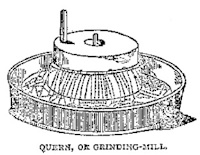 BREAD. — The origin of bread is involved in the obscurity of
distant ages. The Greeks attributed its invention to Pan; but
before they, themselves, had an existence, it was, no doubt, in
use among the primitive nations of mankind. The Chaldeans and
the Egyptians were acquainted with it, and Sarah, the companion
of Abraham, mixed flour and water together, kneaded it, and
covered it with ashes on the hearth. The Scriptures inform us
that leavened bread was known to the Israelites, but it is not
known when the art of fermenting it was discovered. It is said
that the Romans learnt it during their wars with Perseus, king
of Macedon, and that it was introduced to the "imperial city"
about 200 years before the birth of Christ. With them it no
doubt found its way into Britain; but after their departure from
the island, it probably ceased to be used. We know that King
Alfred allowed the unfermented cakes to burn in the neatherd's
cottage; and that, even in the sixteenth century, unfermented
cakes, kneaded by the women, were the only kind of bread known
to the inhabitants of Norway and Sweden. The Italians of this
day consume the greater portion of their flour in the form of
polenta, or soft pudding, vermicelli, and macaroni; and, in
the remoter districts of Scotland, much unfermented bread is
still used. We give a cut of the quern grinding-mill, which,
towards the end of the last century, was in use in that country,
and which is thus described by Dr. Johnson in his "Journey to
the Hebrides:" — "It consists of two stones about a foot and half
in diameter; the lower is a little convex, to which the
concavity of the upper must be fitted. In the middle of the
upper stone is a round hole, and on one side is a long handle.
The grinder sheds the corn gradually into the hole with one
hand, and works the handle round with the other. The corn slides
down the convexity of the lower stone, and by the motion of the
upper, is ground in its passage." Such a primitive piece of
machinery, it may safely be said, has entirely disappeared from
this country. — In other parts of this work, we shall have
opportunities of speaking of bread and bread-making, which, from
its great and general use in the nourishment of mankind, has
emphatically been called the "staff of life." The necessity,
therefore, of having it both pure and good is of the first
importance.
BREAD. — The origin of bread is involved in the obscurity of
distant ages. The Greeks attributed its invention to Pan; but
before they, themselves, had an existence, it was, no doubt, in
use among the primitive nations of mankind. The Chaldeans and
the Egyptians were acquainted with it, and Sarah, the companion
of Abraham, mixed flour and water together, kneaded it, and
covered it with ashes on the hearth. The Scriptures inform us
that leavened bread was known to the Israelites, but it is not
known when the art of fermenting it was discovered. It is said
that the Romans learnt it during their wars with Perseus, king
of Macedon, and that it was introduced to the "imperial city"
about 200 years before the birth of Christ. With them it no
doubt found its way into Britain; but after their departure from
the island, it probably ceased to be used. We know that King
Alfred allowed the unfermented cakes to burn in the neatherd's
cottage; and that, even in the sixteenth century, unfermented
cakes, kneaded by the women, were the only kind of bread known
to the inhabitants of Norway and Sweden. The Italians of this
day consume the greater portion of their flour in the form of
polenta, or soft pudding, vermicelli, and macaroni; and, in
the remoter districts of Scotland, much unfermented bread is
still used. We give a cut of the quern grinding-mill, which,
towards the end of the last century, was in use in that country,
and which is thus described by Dr. Johnson in his "Journey to
the Hebrides:" — "It consists of two stones about a foot and half
in diameter; the lower is a little convex, to which the
concavity of the upper must be fitted. In the middle of the
upper stone is a round hole, and on one side is a long handle.
The grinder sheds the corn gradually into the hole with one
hand, and works the handle round with the other. The corn slides
down the convexity of the lower stone, and by the motion of the
upper, is ground in its passage." Such a primitive piece of
machinery, it may safely be said, has entirely disappeared from
this country. — In other parts of this work, we shall have
opportunities of speaking of bread and bread-making, which, from
its great and general use in the nourishment of mankind, has
emphatically been called the "staff of life." The necessity,
therefore, of having it both pure and good is of the first
importance.
1 large cabbage,
3 carrots,
2 onions,
4 or 5 slices of lean bacon,
salt and pepper to taste,
2 quarts *) ≈ 2 l. of medium stock No.105
Mode. — Scald the cabbage, exit it up and drain it. Line the stewpan with the bacon, put in the cabbage, carrots, and onions; moisten with skimmings from the stock, and simmer very gently, till the cabbage is tender; add the stock, stew softly for half an hour, and carefully skim off every particle of fat. Season and serve.
Time. — 1½ hour.
Average cost, 1s. per quart.
Seasonable in winter.
Sufficient for 8 persons.
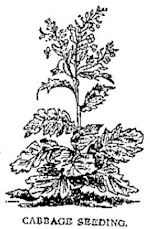 THE CABBAGE. — It is remarkable, that although there is no
country in the world now more plentifully supplied with fruits
and vegetables than Great Britain, yet the greater number of
these had no existence in it before the time of Henry VIII.
Anderson, writing under the date of 1548, says, "The English
cultivated scarcely any vegetables before the last two
centuries. At the commencement of the reign, of Henry VIII.
neither salad, nor carrots, nor cabbages, nor radishes, nor any
other comestibles of a like nature, were grown in any part of
the kingdom; they came from Holland and Flanders." The original
of all the cabbage tribe is the wild plant sea-colewort, which
is to be found wasting whatever sweetness it may have on the
desert air, on many of the cliffs of the south coast of England.
In this state, it scarcely weighs more than half an ounce, yet,
in a cultivated state, to what dimensions can it be made to
grow! However greatly the whole of the tribe is esteemed among
the moderns, by the ancients they were held in yet higher
estimation. The Egyptians adored and raised altars to them, and
the Greeks and Romans ascribed many of the most exalted virtues
to them. Cato affirmed, that the cabbage cured all diseases, and
declared, that it was to its use that the Romans were enabled to
live in health and without the assistance of physicians for 600
years. It was introduced by that people into Germany, Gaul, and,
no doubt, Britain; although, in this last, it may have been
suffered to pass into desuetude for some centuries. The whole
tribe is in general wholesome and nutritive, and forms a
valuable adjunct to animal food.
THE CABBAGE. — It is remarkable, that although there is no
country in the world now more plentifully supplied with fruits
and vegetables than Great Britain, yet the greater number of
these had no existence in it before the time of Henry VIII.
Anderson, writing under the date of 1548, says, "The English
cultivated scarcely any vegetables before the last two
centuries. At the commencement of the reign, of Henry VIII.
neither salad, nor carrots, nor cabbages, nor radishes, nor any
other comestibles of a like nature, were grown in any part of
the kingdom; they came from Holland and Flanders." The original
of all the cabbage tribe is the wild plant sea-colewort, which
is to be found wasting whatever sweetness it may have on the
desert air, on many of the cliffs of the south coast of England.
In this state, it scarcely weighs more than half an ounce, yet,
in a cultivated state, to what dimensions can it be made to
grow! However greatly the whole of the tribe is esteemed among
the moderns, by the ancients they were held in yet higher
estimation. The Egyptians adored and raised altars to them, and
the Greeks and Romans ascribed many of the most exalted virtues
to them. Cato affirmed, that the cabbage cured all diseases, and
declared, that it was to its use that the Romans were enabled to
live in health and without the assistance of physicians for 600
years. It was introduced by that people into Germany, Gaul, and,
no doubt, Britain; although, in this last, it may have been
suffered to pass into desuetude for some centuries. The whole
tribe is in general wholesome and nutritive, and forms a
valuable adjunct to animal food.
(An Excellent Soup, very Beneficial for the Voice.)
3 oz. *) ≈ 86 g. of sago,
½ pint *) ≈ 0.25 l. of cream,
the yolks of 3 eggs,
1 lump of sugar, and seasoning to taste,
1 bay-leaf (if liked),
2 quarts *) ≈ 2 l. of medium stock No. 105.
Mode. — Having washed the sago in boiling water, let it be gradually added to the nearly boiling stock. Simmer for ½ an hour, when it should be well dissolved. Beat up the yolks of the eggs, add to them the boiling cream; stir these quickly in the soup, and serve immediately. Do not let the soup boil, or the eggs will curdle.
Time. — 40 minutes.
Average cost, 1s. 6d. per quart.
Seasonable all the year.
Sufficient for 8 persons.
Note. — This is a soup, the principal ingredients of which, sago and eggs, have always been deemed very beneficial to the chest and throat. In various quantities, and in different preparations, these have been partaken of by the principal singers of the day, including the celebrated Swedish Nightingale, Jenny Lind, and, as they have always avowed, with considerable advantage to the voice, in singing.
4 quarts *) ≈4 l. of liquor in which a leg of mutton or beef
has been boiled,
a few beef-bones,
6 large carrots,
1 turnip;
seasoning of salt and pepper to taste;
cayenne.
Mode. — Put the liquor, bones, onions, turnip, pepper, and salt, into a stewpan, and simmer for 3 hours. Scrape and cut the carrots thin, strain the soup on them, and stew them till soft enough to pulp through a hair sieve or coarse cloth; then boil the pulp with the soup, which should be of the consistency of pea-soup. Add cayenne. Pulp only the red part of the carrot, and make this soup the day before it is wanted.
Time. — 4½ hours.
Average cost per quart, 1½ d.
Seasonable from October to March.
Sufficient for 10 persons.
2 lbs. *) ≈ 900 g. of carrots,
≈3 oz. *) ≈ 100 g. of butter,
seasoning to taste of salt and cayenne,
2 quarts *) ≈ 2 l. of stock or gravy soup.
Mode. — Scrape and cut out all specks from the carrots, wash, and wipe them dry, and then reduce them into quarter-inch slices. Put the butter into a large stewpan, and when it is melted, add 2 lbs. of the sliced carrots, and let them stew gently for an hour without browning. Add to them the soup, and allow them to simmer till tender, — say for nearly an hour. Press them through a strainer with the soup, and add salt and cayenne if required. Boil the whole gently for 5 minutes, skim well, and serve as hot as possible.
Time. — 1-¼ hour.
Average cost per quart, 1s. 1d.
 THE CARROT. — There is a wild carrot which grows in England; but
it is white and small, and not much esteemed. The garden carrot
in general use, was introduced in the reign of Queen Elizabeth,
and was, at first, so highly esteemed, that the ladies wore
leaves of it in their head-dresses. It is of great value in the
culinary art, especially for soups and stews. It can be used
also for beer instead of malt, and, in distillation, it yields a
large quantity of spirit. The carrot is proportionably valuable
as it has more of the red than the yellow part. There is a large
red variety much used by the farmers for colouring butter. As a
garden vegetable, it is what is called the orange-carrot that is
usually cultivated. As a fattening food for cattle, it is
excellent; but for man it is indigestible, on account of its
fibrous matter. Of 1,000 parts, 95 consist of sugar, and 3 of
starch. — The accompanying cut represents a pretty winter
ornament, obtained by placing a cut from the top of the
carrot-root in a shallow vessel of water, when the young leaves
spring forth with a charming freshness and fullness.
THE CARROT. — There is a wild carrot which grows in England; but
it is white and small, and not much esteemed. The garden carrot
in general use, was introduced in the reign of Queen Elizabeth,
and was, at first, so highly esteemed, that the ladies wore
leaves of it in their head-dresses. It is of great value in the
culinary art, especially for soups and stews. It can be used
also for beer instead of malt, and, in distillation, it yields a
large quantity of spirit. The carrot is proportionably valuable
as it has more of the red than the yellow part. There is a large
red variety much used by the farmers for colouring butter. As a
garden vegetable, it is what is called the orange-carrot that is
usually cultivated. As a fattening food for cattle, it is
excellent; but for man it is indigestible, on account of its
fibrous matter. Of 1,000 parts, 95 consist of sugar, and 3 of
starch. — The accompanying cut represents a pretty winter
ornament, obtained by placing a cut from the top of the
carrot-root in a shallow vessel of water, when the young leaves
spring forth with a charming freshness and fullness.
9 heads of celery,
1 teaspoonful of salt,
nutmeg to taste,
1 lump of sugar,
½ pint *) ≈ 250 ml. of strong stock,
a pint *) ≈ 500 ml. of cream, and
2 quarts *) ≈ 2 l. of boiling water.
Mode. — Cut the celery into small pieces; throw it into the water, seasoned with the nutmeg, salt, and sugar. Boil it till sufficiently tender; pass it through a sieve, add the stock, and simmer it for half an hour. Now put in the cream, bring it to the boiling point, and serve immediately.
Time. — 1 hour.
Average cost, 1s. per quart.
Seasonable from September to March.
Sufficient for 10 persons.
Note. — This soup can be made brown, instead of white, by omitting the cream, and colouring it a little. When celery cannot be procured, half a drachm of the seed, finely pounded, will give a flavour to the soup, if put in a quarter of an hour before it is done. A little of the essence of celery will answer the same purpose.
CELERY. — This plant is indigenous to Britain, and, in its wild state, grows by the side of ditches and along some parts of the seacoast. In this state it is called smallaqe, and, to some extent, is a dangerous narcotic. By cultivation, however, it has been brought to the fine flavour which the garden plant possesses. In the vicinity of Manchester it is raised to an enormous size. When our natural observation is assisted by the accurate results ascertained by the light of science, how infinitely does it enhance our delight in contemplating the products of nature! To know, for example, that the endless variety of colour which we see in plants is developed only by the rays of the sun, is to know a truism sublime by its very comprehensiveness. The cause of the whiteness of celery is nothing more than the want of light in its vegetation, and in order that this effect may be produced, the plant is almost wholly covered with earth; the tops of the leaves alone being suffered to appear above the ground.
1 quart *) ≈ 1 l. of young green peas,
a small bunch of parsley,
2 quarts *)
Mode. — Boil the peas till quite tender, with the parsley and onions; then rub them through a sieve, and pour the stock to them. Do not let it boil after the peas are added, or you will spoil the colour. Serve very hot.
Time. — Half an hour.
Average cost 1s. 6d. per quart.
Seasonable from June to the end of August.
Sufficient for 8 persons.
Note. — Cold peas pounded in a mortar, with a little stock added to them, make a very good soup in haste.
PARSLEY. — Among the Greeks, in the classic ages, a crown of parsley was awarded, both in the Nemaean and Isthmian games, and the voluptuous Anacreon pronounces this beautiful herb the emblem of joy and festivity. It has an elegant leaf, and is extensively used in the culinary art. When it was introduced to Britain is not known. There are several varieties, — the plain-leaved and the curled-leaved, celery-parsley, Hamburg parsley, and purslane. The curled is the best, and, from the form of its leaf, has a beautiful appearance on a dish as a garnish. Its flavour is, to many, very agreeable in soups; and although to rabbits, hares, and sheep it is a luxury, to parrots it is a poison. The celery-parsley is used as a celery, and the Hamburg is cultivated only for its roots, which are used as parsnips or carrots, to eat with meat. The purslane is a native of South America, and is not now much in use.
¾ lb. *) ≈ 375 g. of Spanish chestnuts,
¼ pint *) ≈ 125 ml. of cream;
1 quart *)
Mode. — Take the outer rind from the chestnuts, and put them into a large pan of warm water. As soon as this becomes too hot for the fingers to remain in it, take out the chestnuts, peel them quickly, and immerse them in cold water, and wipe and weigh them. Now cover them with good stock, and stew them gently for rather more than ¾ of an hour, or until they break when touched with a fork; then drain, pound, and rub them through a fine sieve reversed; add sufficient stock, mace, cayenne, and salt, and stir it often until it boils, and put in the cream. The stock in which the chestnuts are boiled can be used for the soup, when its sweetness is not objected to, or it may, in part, be added to it; and the rule is, that ¾ lb. of chestnuts should be given to each quart of soup.
Time. — rather more than 1 hour.
Average cost per quart, 1s. 6d.
Seasonable from October to February.
Sufficient for 4 persons.
 THE CHESTNUT. — This fruit is said, by some, to have originally
come from Sardis, in Lydia; and by others, from Castanea, a city
of Thessaly, from which it takes its name. By the ancients it
was much used as a food, and is still common in France and
Italy, to which countries it is, by some, considered indigenous.
In the southern part of the European continent, it is eaten both
raw and roasted. The tree was introduced into Britain by the
Romans; but it only flourishes in the warmer parts of the
island, the fruit rarely arriving at maturity in Scotland. It
attains a great age, as well as an immense size. As a food, it
is the least oily and most farinaceous of all the nuts, and,
therefore, the easiest of digestion. The tree called the horse
chestnut is very different, although its fruit very much
resembles that of the other. Its "nuts," though eaten by horses
and some other animals, are unsuitable for human food.,
THE CHESTNUT. — This fruit is said, by some, to have originally
come from Sardis, in Lydia; and by others, from Castanea, a city
of Thessaly, from which it takes its name. By the ancients it
was much used as a food, and is still common in France and
Italy, to which countries it is, by some, considered indigenous.
In the southern part of the European continent, it is eaten both
raw and roasted. The tree was introduced into Britain by the
Romans; but it only flourishes in the warmer parts of the
island, the fruit rarely arriving at maturity in Scotland. It
attains a great age, as well as an immense size. As a food, it
is the least oily and most farinaceous of all the nuts, and,
therefore, the easiest of digestion. The tree called the horse
chestnut is very different, although its fruit very much
resembles that of the other. Its "nuts," though eaten by horses
and some other animals, are unsuitable for human food.,
6 oz. *) ≈ 200 g. of grated cocoa-nut,
6 oz. *) ≈ 200 g. of rice flour,
½ a teaspoonful of mace;
seasoning to taste of cayenne and salt;
¼ of a pint *) ≈ 125 ml. of boiling cream,
3 quarts *) ≈ 3 l. of medium stock No. 105.
Mode. — Take the dark rind from the cocoa-nut, and grate it down small on a clean grater; weigh it, and allow, for each quart of stock, 2 oz. of the cocoa-nut. Simmer it gently for 1 hour in the stock, which should then be strained closely from it, and thickened for table.
Time. — 2-¼ hours.
Average cost per quart, 1s. 3d.
Seasonable in Autumn.
Sufficient for 10 persons.
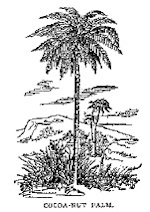 THE COCOA-NUT. — This is the fruit of one of the palms, than which it is questionable if there is any other species of tree marking, in itself, so abundantly the goodness of Providence, in making provision for the wants of man. It grows wild in the Indian seas, and in the eastern parts of Asia; and thence it has been introduced into every part of the tropical regions. To the
natives of those climates, its bark supplies the material for creating their dwellings; its leaves, the means of roofing them; and the leaf-stalks, a kind of gauze for covering their windows, or protecting the baby in the cradle. It is also made into lanterns, masks to screen the face from the heat of the sun, baskets, wicker-work, and even a kind of paper for writing on. Combs, brooms, torches, ropes, matting, and sailcloth are made of its fibers. With these, too, beds are made and cushions stuffed. Oars are supplied by the leaves; drinking-cups,
THE COCOA-NUT. — This is the fruit of one of the palms, than which it is questionable if there is any other species of tree marking, in itself, so abundantly the goodness of Providence, in making provision for the wants of man. It grows wild in the Indian seas, and in the eastern parts of Asia; and thence it has been introduced into every part of the tropical regions. To the
natives of those climates, its bark supplies the material for creating their dwellings; its leaves, the means of roofing them; and the leaf-stalks, a kind of gauze for covering their windows, or protecting the baby in the cradle. It is also made into lanterns, masks to screen the face from the heat of the sun, baskets, wicker-work, and even a kind of paper for writing on. Combs, brooms, torches, ropes, matting, and sailcloth are made of its fibers. With these, too, beds are made and cushions stuffed. Oars are supplied by the leaves; drinking-cups,  spoons, and other domestic utensils by the shells of the nuts; milk by its juice, of which, also, a kind of honey and sugar are prepared. When fermented, it furnishes the means of intoxication; and when the fibres are burned, their ashes supply an alkali for making soap. The buds of the tree bear a striking resemblance to cabbage when boiled; but when they are cropped, the tree dies. In a fresh state, the kernel is eaten raw, and its juice is a most agreeable and refreshing beverage. When the nut is imported to this country, its fruit is, in general, comparatively dry, and is considered indigestible. The tree is one of the least productive of the palm tribe.
4 carrots,
2 sliced onions,
1 cut lettuce, and chervil;
2 oz. *) ≈ 60 g. butter,
1 pint *) ≈ 0.5 l. of lentils,
the crumbs of 2 French rolls,
half a teacupful *) ≈ 60 ml. of rice,
2 quarts *) ≈ 2 l. of medium stock No. 105.
Mode. — Put the vegetables with the butter in the stewpan, and let them simmer 5 minutes; then add the lentils and 1 pint of the stock, and stew gently for half an hour. Now fill it up with the remainder of the stock, let it boil another hour, and put in the crumb of the rolls. When well soaked, rub all through a tammy. Have ready the rice boiled; pour the soup over this, and serve.
Time. — 1¾ hour.
Average cost,1s. 2d. per quart.
Seasonable all the year.
Sufficient for 8 persons.
 THE LENTIL. — This belongs to the legumious or pulse kind of
vegetables, which rank next to the corn plants in their
nutritive properties. The lentil is a variety of the bean tribe,
but in England is not used as human food, although considered
the best of all kinds for pigeons. On the Continent it is
cultivated for soups, as well as for other preparations for the
table; and among the presents which David received from Shobi,
as recounted in the Scriptures, were beans, lentils, and parched
pulse. Among the Egyptians it was extensively used, and among
the Greeks, the Stoics had a maxim, which declared, that "a wise
man acts always with reason, and prepares his own lentils."
Among the Romans it was not much esteemed, and from them the
English may have inherited a prejudice against it, on account,
it is said, of its rendering men indolent. It takes its name
from lentus 'slow,' and, according to Pliny, produces mildness
and moderation of temper.
THE LENTIL. — This belongs to the legumious or pulse kind of
vegetables, which rank next to the corn plants in their
nutritive properties. The lentil is a variety of the bean tribe,
but in England is not used as human food, although considered
the best of all kinds for pigeons. On the Continent it is
cultivated for soups, as well as for other preparations for the
table; and among the presents which David received from Shobi,
as recounted in the Scriptures, were beans, lentils, and parched
pulse. Among the Egyptians it was extensively used, and among
the Greeks, the Stoics had a maxim, which declared, that "a wise
man acts always with reason, and prepares his own lentils."
Among the Romans it was not much esteemed, and from them the
English may have inherited a prejudice against it, on account,
it is said, of its rendering men indolent. It takes its name
from lentus 'slow,' and, according to Pliny, produces mildness
and moderation of temper.
1 large cucumber,
a piece of butter the size of a walnut,
a little chervil and sorrel cut in large pieces,
salt and pepper to taste,
the yolks of 2 eggs,
1 gill *) ≈ 150 ml. of cream,
1 quart *) ≈ 1 l. of medium stock No. 105
Mode. — Pare the cucumber, quarter it, and take out the seeds; cut it in thin slices, put these on a plate with a little salt, to draw the water from them; drain, and put them in your stewpan, with the butter. When they are warmed through, without being browned, pour the stock on them. Add the sorrel, chervil, and seasoning, and boil for 40 minutes. Mix the well-beaten yolks of the eggs with the cream, which add at the moment of serving.
Time. — 1 hour.
Average cost, 1s. 2d. per quart.
Seasonable from June to September.
Sufficient for 4 persons.
THE CUCUMBER. — The antiquity of this fruit is very great. In the sacred writings we find that the people of Israel regretted it, whilst sojourning in the desert; and at the present time, the cucumber, and other fruits of its class, form a large portion of the food of the Egyptian people. By the Eastern nations generally, as well as by the Greeks and Romans, it was greatly esteemed. Like the melon, it was originally brought from Asia by the Romans, and in the 14th century it was common in England, although, in the time of the wars of "the Roses," it seems no longer to have been cultivated. It is a cold food, and of difficult digestion when eaten raw. As a preserved sweetmeat, however, it is esteemed one of the most agreeable.
A tablespoonful of flour,
4 eggs,
2 small blades offinely-pounded mace,
2 quarts *) ≈ 2 l. of stock No. 105.
Mode. — Beat up the flour smoothly in a teaspoonful of cold stock, and put in the eggs; throw them into boiling stock, stirring all the time. Simmer for ¼ of an hour. Season and serve with a French roll in the tureen, or fried sippets of bread.
Time. ½ an hour.
Average cost,11d. per quart.
Seasonable all the year.
Sufficient for 8 persons.
1 turnip,
1 small carrot,
½ head of celery,
6 green onions shred very fine,
1 lettuce cut small,
chervil,
¼ pint *) ≈ 125 ml. of asparagus cut small,
¼ pint *) ≈ 125 ml. of peas,
2 oz. *) ≈ 60 g. butter,
the yolks of 4 eggs,
½ pint *) ≈ 250 ml. of cream,
salt to taste,
1 lump of sugar,
2 quarts *) ≈ 2 l. of stock No. 105
Mode. — Put the vegetables in the butter to stew gently for an hour with a teacupful of stock; then add the remainder of the stock, and simmer for another hour. Now beat the yolks of the eggs well, mix with the cream (previously boiled), and strain through a hair sieve. Take the soup off the fire, put the eggs, &c. to it, and keep stirring it well. Bring it to a boil, but do not leave off stirring, or the eggs will curdle. Season with salt, and add the sugar.
Time. — 24 hours.
Average cost, 1s. 9d. per quart.
Seasonable from May to August.
Sufficient for 8 persons.
CHERVIL. — Although the roots of this plant are poisonous, its leaves are tender, and are used in salads. In antiquity it made a relishing dish, when prepared with oil, wine, and gravy. It is a native of various parts of Europe; and the species cultivated in the gardens of Paris, has beautifully frizzled leaves.
5 onions,
5 heads of celery,
10 moderate-sized potatoes,
3 oz. *) ≈ 100 g. butter,
½ pint *) ≈ 250 ml. of water,
½ pint *) ≈ 250 ml. of cream,
2 quarts *) ≈ 2 l.of stock No. 105.
Mode. — Slice the onions, celery, and potatoes, and put them with the butter and water into a stewpan, and simmer for an hour. Then fill up the stewpan with stock, and boil gently till the potatoes are done, which will be in about an hour. Rub all through a tammy, and add the cream (previously boiled). Do not let it boil after the cream is put in.
Time. — 2½ hours.
Average cost,1s. 4d. per quart.
Seasonable from September to May.
Sufficient for 8 persons.
Note. — This soup can be made with water instead of stock.
½ pint *) ≈ 250 ml. of carrots,
½ pint *) ≈ 250 ml. of turnips,
¼ pint *) ≈ 125 ml. of onions,
2 or 3 leeks,
½ head of celery,
1 lettuce,
a little sorrel and chervil, if liked,
2 oz. *) ≈ 50 g. of butter,
2 quarts *) ≈ 2 l. of stock No. 105.
Mode. — Cut the vegetables into strips of about 1-¼ inch long, and be particular they are all the same size, or some will be hard whilst the others will be done to a pulp. Cut the lettuce, sorrel, and chervil into larger pieces; fry the carrots in the butter, and pour the stock boiling to them. When this is done, add all the other vegetables, and herbs, and stew gently for at least an hour. Skim off all the fat, pour the soup over thin slices of bread, cut round about the size of a shilling, and serve.
Time. — 1½ hour.
Average cost, 1s. 3d. per quart.
Seasonable all the year.
Sufficient for 8 persons.
Note. — In summer, green peas, asparagus-tops, French beans, &c. can be added. When the vegetables are very strong, instead of frying them in butter at first, they should be blanched, and afterwards simmered in the stock.
 SORREL. — This is one of the spinaceous plants, which take their name from spinach, which is the chief among them. It is little used in English cookery, but a great deal in French, in which it is employed for soups, sauces, and salads. In English meadows it is usually left to grow wild; but in France, where it
is cultivated, its flavour is greatly improved.
SORREL. — This is one of the spinaceous plants, which take their name from spinach, which is the chief among them. It is little used in English cookery, but a great deal in French, in which it is employed for soups, sauces, and salads. In English meadows it is usually left to grow wild; but in France, where it
is cultivated, its flavour is greatly improved.
Half an ox-head or cow-heel,
a teacupful *) ≈ 5 ml. of toasted oatmeal,
salt to taste,
2 handfuls of greens,
3 quarts *) ≈ 3 l. of water.
Mode. — Make a broth of the ox-head or cow-heel, and boil it till oil floats on the top of the liquor, then boil the greens, shred, in it. Put the oatmeal, with a little salt, into a basin, and mix with it quickly a teacupful of the fat broth: it should not run into one doughy mass, but form knots. Stir it into the whole, give one boil, and serve very hot.
Time. — 4 hours.
Average cost, 8d. per quart.
Seasonable all the year, but more suitable in winter.
Sufficient for 10 persons.
A sheep's head,
3 quarts *) ≈ 3 l. of water,
12 leeks cut small,
pepper and salt to taste,
oatmeal to thicken.
Mode. — Prepare the head, either by skinning or cleaning the skin very nicely; split it in two; take out the brains, and put it into boiling water; add the leeks and seasoning, and simmer very gently for 4 hours. Mix smoothly, with cold water, as much oatmeal as will make the soup tolerably thick; pour it into the soup; continue stirring till the whole is blended and well done, and serve.
Time. — 4½ hours.
Average cost, 4d. per quart.
Seasonable in winter.
Sufficient for 10 persons.
A capon or large fowl (sometimes an old cock, from which the recipe takes its name, is used), which should be trussed as for boiling;
2 or 3 bunches of fine leeks,
5 quarts *) ≈ 5 l. of stock No. 105,
pepper and salt to taste.
Mode. — Well wash the leeks (and, if old, scald them in boiling water for a few minutes), taking off the roots and part of the heads, and cut them into lengths of about an inch. Put the fowl into the stock, with, at first, one half of the leeks, and allow it to simmer gently. In half an hour add the remaining leeks, and then it may simmer for 3 or 4 hours longer. It should be carefully skimmed, and can be seasoned to taste. In serving, take out the fowl, and carve it neatly, placing the pieces in a tureen, and pouring over them the soup, which should be very thick of leeks (a purée of leeks the French would call it).
Time. — 4 hours.
Average cost, 1s. 6d. per quart; or, with stock No. 106, 1s.
Seasonable in winter.
Sufficient for 10 persons.
Note. — Without the fowl, the above, which would then be merely called leek soup, is very good, and also economical. Cock-a-leekie was largely consumed at the Burns Centenary Festival at the Crystal Palace, Sydenham, in 1859.
 THE LEEK. — As in the case of the cucumber, this vegetable was bewailed by the Israelites in their journey through the desert. It is one of the alliaceous tribe, which consists of the onion, garlic, chive, shallot, and leek. These, as articles of food, are perhaps more widely diffused over the face of the earth than any other genus of edible plants. It is the national badge of the Welsh, and tradition ascribes to St. David its introduction to that part of Britain. The origin of the wearing of the leek on St. David's day *)
The feast day of Saint David, the patron saint of Wales, is on the 1st March,, among that people, is thus given in "BEETON'S DICTIONARY of UNIVERSAL INFORMATION:" —
"It probably originated from the custom of Cymhortha, or the friendly aid, practised among farmers. In some districts of South Wales, all the neighbours of a small farmer were wont to appoint a day when they attended to plough his land, and the like; and, at such time, it was the custom for each to bring his portion of leeks with him for making the broth or soup." (See ST. DAVID.)
Others derive the origin of the custom from the battle of Cressy. The plant, when grown in Wales and Scotland, is sharper than it is in England, and its flavour is preferred by many to that of the onion in broth. It is very wholesome, and, to prevent its tainting the breath, should be well boiled.
3 oz. *) ≈ 100 g. of macaroni,
a piece of butter the size of a walnut,
salt to taste,
2 quarts *) ≈ 2 l. of clear stock No. 105
Mode. — Throw the macaroni and butter into boiling water, with a pinch of salt, and simmer for ½ an hour. When it is tender, drain and cut it into thin rings or lengths, and drop it into the boiling stock. Stew gently for 15 minutes, and serve grated Parmesan cheese with it.
Time.-¾ hour.
Average cost, 1s. per quart.
Seasonable all the year.
Sufficient for 8 persons.
 MACARONI. — This is the favourite food of Italy, where, especially among the Neapolitans, it may be regarded as the staff of life. "The crowd of London," says Mr. Forsyth, "is a double line in quick motion; it is the crowd of business. The crowd of Naples consists in a general tide rolling up and down, and in the middle of this tide, a hundred eddies of men. You are stopped by a carpenter's bench, you are lost among shoemakers' stalls, and you dash among the pots of a macaroni stall. "This article of food is nothing more than a thick paste, made of the best wheaten flour, with a small quantity of water. When it has been well worked, it is put into a hollow cylindrical vessel, pierced with holes of the size of tobacco-pipes at the bottom. Through these holes the mass is forced by a powerful screw bearing on a piece of wood made exactly to fit the inside of the cylinder. Whilst issuing from the holes, it is partially baked by a fire placed below the cylinder, and is, at the same time, drawn away and hung over rods placed about the room, in order to dry. In a few days it is fit for use. As it is both wholesome and nutritious, it ought to be much more used by all classes in England than it is. It generally accompanies Parmesan cheese to the tables of the rich, but is also used for thickening soups and making puddings.
6 oz. *) ≈ 200 g. butter,
6 onions sliced,
4 heads of celery,
2 lettuces,
a small bunch of parsley,
2 handfuls of spinach,
3 pieces of bread-crust,
2 blades of mace,
salt and pepper to taste,
the yolks of 2 eggs,
3 teaspoonfuls of vinegar,
2 quarts *) ≈ 2 l. of water.
Mode. — Melt the butter in a stewpan, and put in the onions to stew gently for 3 or 4 minutes; then add the celery, spinach, lettuces, and parsley, cut small. Stir the ingredients well for 10 minutes. Now put in the water, bread, seasoning, and mace. Boil gently for 1½ hour, and, at the moment of serving, beat in the yolks of the eggs and the vinegar, but do not let it boil, or the eggs will curdle.
Time. — 2 hours.
Average cost, 6d. per quart.
Seasonable all the year.
Sufficient for 8 persons.
 THE LETTUCE. — This is one of the acetarious vegetables, which comprise a large class, chiefly used as pickles, salads, and other condiments. The lettuce has in all antiquity been distinguished as a kitchen-garden plant. It was, without preparation, eaten by the Hebrews with the Paschal lamb; the Greeks delighted in it, and the Romans, in the time of Domitian, had it prepared with eggs, and served in the first course at their tables, merely to excite their appetites. Its botanical name is Lactuca, so called from the milky juice it exudes when its stalks are cut. It possesses a narcotic virtue, noticed by ancient physicians; and even in our day a lettuce supper is deemed conducive to repose. Its proper character, however, is that of a cooling summer vegetable, not very nutritive, but serving as a corrective, or diluent of animal food.
2 quarts *) ≈ 2 l. of milk,
1 saltspoonful of salt,
1 teaspoonful of powdered cinnamon,
3 teaspoonfuls of pounded sugar, or more if liked,
4 thin slices of bread,
the yolks of 6 eggs.
Mode. — Boil the milk with the salt, cinnamon, and sugar; lay the bread in a deep dish, pour over it a little of the milk, and keep it hot over a stove, without burning. Beat up the yolks of the eggs, add them to the milk, and stir it over the fire till it thickens. Do not let it curdle. Pour it upon the bread, and serve.
Time.-¾ of an hour.
Average cost, 8d. per quart.
Seasonable all the year.
Sufficient for 10 children.
6 large onions,
2 oz. *) ≈ 60 g. of butter,
salt and pepper to taste,
¼ pint *) ≈ 125 ml. of cream,
1 quart *) ≈ 1 l. of stock No. 105.
Mode. — Chop the onions, put them in the butter, stir them occasionally, but do not let them brown. When tender, put the stock to them, and season; strain the soup, and add the boiling cream.
Time. — 1½ hour.
Average cost, 1s. per quart.
Seasonable in winter.
Sufficient for 4 persons.
8 middling-sized onions,
3 oz. *) ≈ 100 g. of butter,
a tablespoonful of rice-flour,
salt and pepper to taste,
1 teaspoonful of powdered sugar,
thickening of butter and flour,
2 quarts *) ≈ 2 l. of water.
Mode. — Cut the onions small, put them in the stewpan with the butter, and fry them well; mix the rice-flour smoothly with the water, add the onions, seasoning, and sugar, and simmer till tender. Thicken with butter and flour, and serve.
Time. — 2 hours.
Average cost,4d. per quart.
Seasonable in winter.
Sufficient for 8 persons.
 THE ONION. — Like the cabbage, this plant was erected into an object of worship by the idolatrous Egyptians 2,000 years before the Christian era, and it still forms a favourite food in the country of these people, as well as in other parts of Africa. When it was first introduced to England, has not been ascertained; but it has long been in use, and esteemed as a favourite seasoning plant to various dishes. In warmer climates it is much milder in its flavour; and such as are grown in Spain and Portugal, are, comparatively speaking, very large, and are often eaten both in a boiled and roasted state. The Strasburg is the most esteemed; and, although all the species have highly nutritive properties, they impart such a disagreeable odour to the breath, that they are often rejected even where they are liked. Chewing a little raw parsley is said to remove this odour.
2 lbs. *) ≈ 0.9 kg. of cabbage, or Savoy greens;
¼ lb. *) ≈ 110 g. of butter or dripping,
salt and pepper to taste,
oatmeal for thickening,
2 quarts *) ≈ 2 l.of water.
Mode. — Chop the cabbage very fine, thicken the water with oatmeal, put in the cabbage and butter, or dripping; season and simmer for 1½ hour. It can be made sooner by blanching and mashing the greens, adding any good liquor that a joint has been boiled in, and then further thicken with bread or pounded biscuit.
Time — 1½ hour.
Average cost, 1½ d. per quart.
Seasonable all the year, but more suitable in winter.
Sufficient for 8 persons.
THE SAVOY. — This is a close-hearted wrinkle-leaved cabbage, sweet and tender, especially the middle leaves, and in season from November to spring. The yellow species bears hard weather without injury, whilst the dwarf kind are improved and rendered more tender by frost.
1 lb. *) ≈ 450 g. of sliced parsnips,
2 oz. *) ≈ 57 g. of butter,
salt and cayenne to taste,
1 quart *) ≈ 1 l. of stock No. 106.
Mode. — Put the parsnips into the stewpan with the butter, which has been previously melted, and simmer them till quite tender. Then add nearly a pint of stock, and boil together for half an hour. Pass all through a fine strainer, and put to it the remainder of the stock. Season, boil, and serve immediately.
Time. — 2 hours.
Average cost, 6d. per quart.
Seasonable from October to April.
Sufficient for 4 persons.
THE PARSNIP. — This is a biennial plant, with a root like a carrot, which, in nutritive and saccharine matter, it nearly equals. It is a native of Britain, and, in its wild state, may be found, in many parts, growing by the road-sides. It is also to be found, generally distributed over Europe; and, in Catholic countries, is mostly used with salt fish, in Lent. In Scotland it forms an excellent dish, when beat up with butter and potatoes; it is, also, excellent when fried. In Ireland it is found to yield, in conjunction with the hop, a pleasant beverage; and it contains as much spirit as the carrot, and makes an excellent wine. Its proportion of nutritive matter is 99 parts in 1,000; 9 being mucilage and 90 sugar.
3 pints *) ≈ 1.5 l. of green peas,
¼ lb. *) ≈ 125 g. of butter,
2 or three thin slices of ham,
6 onions sliced,
4 shredded lettuces,
the crumb of 2 French rolls,
2 handfuls of spinach,
1 lump of sugar,
2 quarts *) ≈ 2 l. of common stock.
Mode. — Put the butter, ham, 1 quart of the peas, onions, and lettuces, to a pint of stock, and simmer for an hour; then add the remainder of the stock, with the crumb of the French rolls, and boil for another hour. Now boil the spinach, and squeeze it very dry. Rub the soup through a sieve, and the spinach with it, to colour it. Have ready a pint of young peas boiled; add them to the soup, put in the sugar, give one boil, and serve. If necessary, add salt.
Time. — 2½ hours.
Average cost, 1s. 9d. per quart.
Seasonable from June to the end of August.
Sufficient for 10 persons.
Note. — It will be well to add, if the peas are not quite young, a little sugar. Where economy is essential, water may be used instead of stock for this soup, boiling in it likewise the pea-shells; but use a double quantity of vegetables.
1 quart *) ≈ 1 l. of split peas,
2 lbs. *) ≈ 900 g. of shin of beef,
trimmings of meat or
poultry,
a slice of bacon,
2 large carrots,
2 turnips,
5 large onions,
1 head of celery, seasoning to taste,
2 quarts *) ≈ 2 l. of soft water,
any bones left from roast meat,
2 quarts *) ≈ 2 l. of common stock, or liquor in which a joint of meat has been boiled.
Mode. — Put the peas to soak over-night in soft water, and float off such as rise to the top. Boil them in the water till tender enough to pulp; then add the ingredients mentioned above, and simmer for 2 hours, stirring it occasionally. Pass the whole through a sieve, skim well, season, and serve with toasted bread cut in dice.
Time. — 4 hours.
Average cost, 6d. per quart.
Seasonable all the year round, but more suitable for cold weather.
Sufficient for 12 persons.
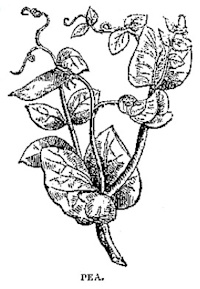 THE PEA. — It is supposed that the common gray pea, found wild in Greece, and other parts of the Levant, is the original of the common garden pea, and of all the domestic varieties belonging to it. The gray, or field pea, called bisallie by the French, is less subject to run into varieties than the garden kinds, and is considered by some, perhaps on that account, to be the wild plant, retaining still a large proportion of its original habit. From the tendency of all other varieties "to run away" and become different to what they originally were, it is very difficult to determine the races to which they belong. The pea was well known to the Romans, and, probably, was introduced to Britain at an early period; for we find peas mentioned by Lydgate, a poet of the 15th century, as being hawked in London. They seem, however, for a considerable time, to have fallen out of use; for, in the reign of Queen Elizabeth, Fuller tells us they were brought from Holland, and were accounted "fit dainties for ladies, they came so far and cost so dear." There are some varieties of peas which have no lining in their pods, which are eaten cooked in the same way as kidney-beans. They are called sugar peas, and the best variety is the large crooked sugar, which is also very good, used in the common way, as a culinary vegetable. There is also a white sort, which readily splits when subjected to the action of millstones set wide apart, so as not to grind them. These are used largely for soups, and especially for sea-stores. From the quantity of farinaceous and saccharine matter contained in the pea, it is highly nutritious as an article of food.
¼ lb. *) ≈ 125 g. of onions,
¼ lb. *) ≈ 125 g. of carrots,
2 oz. *) ≈ 60 g. of celery,
¾ lb. *) ≈ 375 g. of split peas,
a little mint, shred fine;
1 tablespoonful of coarse brown sugar,
salt and pepper to taste,
4 quarts *) ≈ 4 l. of water, or liquor in which a joint of meat has been boiled.
Mode. — Fry the vegetables for 10 minutes in a little butter or dripping, previously cutting them up in small pieces; pour the water on them, and when boiling add the peas. Let them simmer for nearly 3 hours, or until the peas are thoroughly done. Add the sugar, seasoning, and mint; boil for ¼ of an hour, and serve.
Time. — 3½ hours.
Average cost, 1½ d. per quart.
Seasonable in winter.
Sufficient for 12 persons.
4 lbs. *) ≈ 2 kg. of mealy potatoes, boiled or steamed very dry,
pepper and salt to taste,
2 quarts *) ≈ 2 l.
of stock No. 105
Mode. — When the potatoes are boiled, mash them smoothly, that no lumps remain, and gradually put them to the boiling stock; pass it through a sieve, season, and simmer for 5 minutes. Skim well, and serve with fried bread.
Time.-½ hour.
Average cost, 10d. per quart.
Seasonable from September to March.
Sufficient for 8 persons.
1 lb. *) ≈ 450 g. of shin of beef,
1 lb. *) ≈ 450 g. of potatoes,
1 onion,
½ a pint *) ≈ 250 ml. of peas,
2 oz. *) ≈ 60 g. of rice,
2 heads of celery,
pepper and salt to taste,
3 quarts *) ≈ 3 l. of water.
Mode. — Cut the beef into thin slices, chop the potatoes and onion, and put them in a stewpan with the water, peas, and rice. Stew gently till the gravy is drawn from the meat; strain it off, take out the beef, and pulp the other ingredients through a coarse sieve. Put the pulp back in the soup, cut up the celery in it, and simmer till this is tender. Season, and serve with fried bread cut into it.
Time. — 3 hours.
Average cost, 4d. per quart.
Seasonable from September to March.
Sufficient for 12 persons.
4 middle-sized potatoes well pared,
a thick slice of bread,
6 leeks peeled and cut into thin slices as far as the white extends upwards from the roots,
2 quarts *) ≈ 2 l. of water.
a teacupful of rice,
a teaspoonful of salt,
and half that of pepper.
Mode. — The water must be completely boiling before anything is put into it; then add the whole of the ingredients at once, with the exception of the rice, the salt, and the pepper. Cover, and let these come to a brisk boil; put in the others, and let the whole boil slowly for an hour, or till all the ingredients are thoroughly done, and their several juices extracted and mixed.
Time. — 2½ hours.
Average cost, 3d. per quart.
Sufficient for 8 persons.
Seasonable in winter.
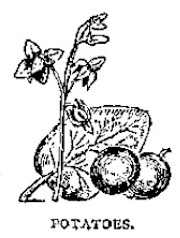 THE POTATO. — Humboldt doubted whether this root was a native of South America; but it has been found growing wild both in Chili and Buenos Ayres. It was first brought to Spain from the neighbourhood of Quito, in the early part of the sixteenth century, first to England from Virginia, in 1586, and first planted by Sir Walter Raleigh, on his estate of Youghal, near Cork, in Ireland. Thence it was brought and planted in Lancashire, in England, and was, at first, recommended to be eaten as a delicate dish, and not as common food. This was in 1587. Nutritious Properties. — Of a thousand parts of the potato, Sir H. Davy found about a fourth nutritive; say, 200 mucilage or starch, 20 sugar, and 30 gluten
½ a pint *) ≈ 250 ml. of green peas,
if in season, a little chervil,
2 shredded lettuces,
2 onions,
a very small bunch of parsley,
2 oz. *) ≈ 60 g. of butter,
the yolks of 3 eggs,
1 pint *) ≈ 0.5 l. of water,
seasoning to taste,
2 quarts *) ≈ 2 l. of stock No. 105
Mode. — Put in a very clean stewpan the chervil, lettuces, onions, parsley, and butter, to 1 pint of water, and let them simmer till tender. Season with salt and pepper; when done, strain off the vegetables, and put two-thirds of the liquor they were boiled in to the stock. Beat up the yolks of the eggs with the other third, give it a toss over the fire, and at the moment of serving, add this, with the vegetables which you strained off, to the soup.
Time.-¾ of an hour.
Average cost, 1s. per quart.
Seasonable from May to October.
Sufficient for 8 persons.
THE PRINCE Of WALES.--This soup was invented by a philanthropic friend of the Editress, to be distributed among the poor of a considerable village, when the Prince of Wales attained his majority, on the 9th November, 1859. Accompanying this fact, the following notice, which appears in "BEETON'S DICTIONARY OF UNIVERSAL INFORMATION" may appropriately be introduced, premising that British princes attain their majority in their 18th year, whilst mortals of ordinary rank do not arrive at that period till their 21st.--"ALBERT EDWARD, Prince of Wales, and heir to the British throne, merits a place in this work on account of the high responsibilities which he is, in all probability, destined to fulfil as sovereign of the British empire. On the 10th of November, 1858, he was gazetted as having been invested with the rank of a colonel in the army. Speaking of this circumstance, the Times said,--'The significance of this event is, that it marks the period when the heir to the British throne is about to take rank among men, and to enter formally upon a career, which every loyal subject of the queen will pray may be a long and a happy one, for his own sake and for the sake of the vast empire which, in the course of nature, he will one day be called to govern. The best wish that we can offer for the young prince is, that in his own path he may ever keep before him the bright example of his royal mother, and show himself worthy of her name.' There are few in these realms whonwill not give a fervent response to these sentiments. B. November 9th, 1841."
½ *)≈ 250 .la pint of green peas,
if in season, a little chervil,
2 shredded lettuces,
2 onions,
a very small bunch of parsley,
2 oz. *) ≈ 60 g. of butter,
the yolks of 3 eggs,
1 pint *)≈500mlof water,
seasoning to taste,
2 quarts *) ≈ 2 l. of stock No. 105.
Mode. — Put in a very clean stewpan the chervil, lettuces, onions, parsley, and butter, to 1 pint of water, and let them simmer till tender. Season with salt and pepper; when done, strain off the vegetables, and put two-thirds of the liquor they were boiled in to the stock. Beat up the yolks of the eggs with the other third, give it a toss over the fire, and at the moment of serving, add this, with the vegetables which you strained off, to the soup.
Time.— 3/4 of an hour.
Average cost, 1s. per quart.
Seasonable from May to October.
Sufficient for 8 persons.
4 oz. *) ≈ 110 g. of Patna rice,
salt,
cayenne, and mace,
2 quarts *) ≈ 2 l. of white stock.
Mode. — Throw the rice into boiling water, and let it remain 5 minutes; then pour it into a sieve, and allow it to drain well. Now add it to the stock boiling, and allow it to stew till it is quite tender; season to taste. Serve quickly.
Time. — 1 hour.
Average cost, 1s. 3d. per quart.
Seasonable all the year.
Sufficient for 8 persons.
 RICE. — This is a plant of Indian origin, and has formed the principal food of the Indian and Chinese people from the most remote antiquity. Both Pliny and Dioscorides class it with the cereals, though Galen places it among the vegetables. Be this as it may, however, it was imported to Greece, from India, about 286 years before Christ, and by the ancients it was esteemed both nutritious and fattening. There are three kinds of rice, — the Hill rice, the Patna, and the Carolina, of the United States. Of these, only the two latter are imported to this country, and the Carolina is considered the best, as it is the dearest. The nourishing properties of rice are greatly inferior to those of wheat; but it is both a light and a wholesome food. In combination with other foods, its nutritive qualities are greatly increased; but from its having little stimulating power, it is apt, when taken in large quantities alone, to lie long on the stomach.
6 oz. *) ≈ 175 g. of rice,
the yolks of 4 eggs,
½ a pint *) ≈ 250 ml. of cream,
rather more than 2 quarts *) ≈ 2 l. of stock No. 105
Mode. — Boil the rice in the stock, and rub half of it through a tammy; put the stock in the stewpan, add all the rice, and simmer gently for 5 minutes. Beat the yolks of the eggs, mix them with the cream (previously boiled), and strain through a hair sieve; take the soup off the fire, add the eggs and cream, stirring frequently. Heat it gradually, stirring all the time; but do not let it boil, or the eggs will curdle.
Time. — 2 hours.
Average cost, 1s. 4d. per quart.
Seasonable all the year.
Sufficient for 8 persons.
5 oz. *) ≈ 150 g. of sago,
2 quarts *) ≈ 2 l. of stock No. 105
Mode. — Wash the sago in boiling water, and add it, by degrees, to the boiling stock, and simmer till the sago is entirely dissolved, and forms a sort of jelly.
Time. — Nearly an hour.
Average cost, 10d. per quart.
Sufficient for 8 persons.
Seasonable all the year.
Note. — The yolks of 2 eggs, beaten up with a little cream, previously boiled, and added at the moment of serving, much improves this soup.
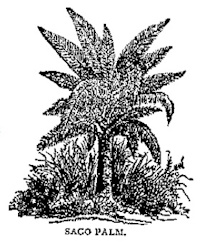 SAGO. — The farinaceous food of this name constitutes the pith of the SAGO tree (the Sagus farinifera of Linnaeus), which grows spontaneously in the East Indies and in the archipelago of the Indian Ocean. There it forms the principal farinaceous diet of the inhabitants. In order to procure it, the tree is felled and sawn in pieces. The pith is then taken out, and put in receptacles of cold water, where it is stirred until the flour separates from the filaments, and sinks to the bottom, where it is suffered to remain until the water is poured off, when it is taken out and spread on wicker frames to dry. To give it the round granular form in which we find it come to this country, it is passed through a colander, then rubbed into little balls, and dried. The tree is not fit for felling until it has attained a growth of seven years, when a single trunk will yield 600 lbs. weight; and, as an acre of ground will grow 430 of these trees, a large return of flour is the result. The best quality has a slightly reddish hue, and easily dissolves to a jelly, in hot water. As a restorative diet, it is much used.
5 oz. *) ≈ 150 g. of semolina,
2 quarts *) ≈ 2 l. of boiling stock,No. 105, or 106.
Mode. — Drop the semolina into the boiling stock, and keep stirring, to prevent its burning. Simmer gently for half an hour, and serve.
Time.-½ an hour.
Average cost, 10d. per quart, or 4d.
Seasonable all the year.
Sufficient for 8 persons.
SEMOLINA. — This is the heart of the grano duro wheat of Italy, which is imported for the purpose of making the best vermicelli. It has a coarse appearance, and may be purchased at the Italian warehouses. It is also called soojee; and semoletta is another name for a finer sort.
4 eggs,
½ pint *) ≈ 250 ml. of cream,
2 oz. *) ≈ 60 g. of fresh butter,
salt and pepper to taste,
a little flour to thicken,
2 quarts *) ≈ 2 l. of bouillon, No. 105
Mode. — Beat the eggs, put them into a stewpan, and add the cream, butter, and seasoning; stir in as much flour as will bring it to the consistency of dough; make it into balls, either round or egg-shaped, and fry them in butter; put them in the tureen, and pour the boiling bouillon over them.
Time. — 1 hour.
Average cost, 1s. 3d. per quart.
Seasonable all the year.
Sufficient for 8 persons.
Note. — This recipe was communicated to the Editress by an English gentleman, who was present at the battle of Solferino, on June 24, 1859, and who was requested by some of Victor Emmanuel's troops, on the day before the battle, to partake of a portion of their potage. He willingly enough consented, and found that these clever campaigners had made a most palatable dish from very easily-procured materials. In sending the recipe for insertion in this work, he has, however, Anglicised, and somewhat, he thinks, improved it.
As much spinach as, when boiled, will half fill a vegetable-dish,
2 quarts *) ≈ 2 l. of very clear medium stock, No. 105
Mode. — Make the cooked spinach into balls the size of an egg, and slip them into the soup-tureen. This is a very elegant soup, the green of the spinach forming a pretty contrast to the brown gravy.
Time. — 1 hour.
Average cost,1s. per quart.
2Seasonable from October to June.

SPINACH. — This plant was unknown by the ancients, although it was cultivated in the monastic gardens of the continent in the middle of the 14th century. Some say, that it was originally brought from Spain; but there is a wild species growing in England, and cultivated in Lincolnshire, in preference to the other. There are three varieties in use; the round-leaved, the triangular-leaved, and Flanders spinach, known by its large leaves. They all form a useful ingredient in soup; but the leaves are sometimes boiled alone, mashed, and eaten as greens.
5 oz. *) ≈ 150 g. of tapioca,
2 quarts *) ≈ 2 l. of stock No. 105 or 106.
Mode. — Put the tapioca into cold stock, and bring it gradually to a boil. Simmer gently till tender, and serve.
Time. — Rather more than 1 hour.
Average cost. 1s. or 6d. per quart.
Seasonable all the year.
Sufficient for 8 persons.
TAPIOCA. — This excellent farinaceous food is the produce of the pith of the cassava-tree, and is made in the East Indies, and also in Brazil. It is, by washing, procured as a starch from the tree, then dried, either in the sun or on plates of hot iron, and afterwards broken into grains, in which form it is imported into this country. Its nutritive properties are large, and as a food for persons of delicate digestion, or for children, it is in great estimation. "No amylaceous substance," says Dr. Christison, "is so much relished by infants about the time of weaning; and in them it is less apt to become sour during digestion than any other farinaceous food, even arrowroot not excepted."
3 oz. *) ≈ 100 g. of butter,
9 good-sized turnips,
4 onions,
2 quarts *) ≈ 2 l. of stock No. 106,
seasoning to taste.
Mode. — Melt the butter in the stewpan, but do not let it boil; wash, drain, and slice the turnips and onions very thin; put them in the butter, with a teacupful of stock, and stew very gently for an hour. Then add the remainder of the stock, and simmer another hour. Rub it through a tammy, put it back into the stewpan, but do not let it boil. Serve very hot.
Time. — 2½ hours.
Average cost, 8d. per quart.
Seasonable from October to March.
Sufficient for 8 persons.
Note. — By adding a little cream, this soup will be much improved.
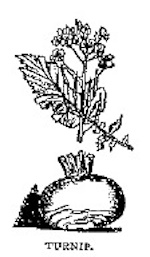 THE TURNIP. — Although turnips grow wild in England, they are not the original of the cultivated vegetable made use of in this country. In ancient times they were grown for cattle by the Romans, and in Germany and the Low Countries they have from time immemorial been raised for the same purpose. In their cultivated state, they are generally supposed to have been introduced to England from Hanover, in the time of George I.; but this has been doubted, as George II. caused a description of the Norfolk system to be sent to his Hanoverian subjects, for their enlightenment in the art of turnip culture. As a culinary vegetable, it is excellent, whether eaten alone, mashed, or mixed with soups und stews. Its nutritious matter, however, is small, being only 42 parts in 1,000.
4 young vegetable marrows, or more, if very small,
½ pint *) ≈ 250 ml. of cream,
salt and white pepper to taste,
2 quarts *) ≈ 2 l. of white
stock, No. 107.
Mode. — Pare and slice the marrows, and put them in the stock boiling. When done almost to a mash, press them through a sieve, and at the moment of serving, add the boiling cream and seasoning.
Time. — 1 hour.
Average cost, 1s. 2d. per quart.
Seasonable in summer.
Sufficient for 8 persons.
 THE VEGETABLE MARROW. — This is a variety of the gourd family, brought from Persia by an East-India ship, and only recently introduced to Britain. It is already cultivated to a considerable extent, and, by many, is highly esteemed when fried with butter. It is, however, dressed in different ways, either by stewing or boiling, and, besides, made into pies.
7 oz. *) ≈ 200 g, of carrot,
10 oz. *) ≈ 300 g. of parsnip,
10 oz. *) ≈ 300 g. of potato,
cut into thin slices;
1.25 oz. *) ≈ 35 g. of butter,
5 teaspoonfuls of flour,
a teaspoonful of made mustard,
salt and pepper to taste,
the yolks of 2 eggs,
rather more than 2 quarts *) ≈ 2 l. of water.
Mode. — Boil the vegetables in the water 2½ hours; stir them often, and if the water boils away too quickly, add more, as there should be 2 quarts of soup when done. Mix up in a basin the butter and flour, mustard, salt, and pepper, with a teacupful of cold water; stir in the soup, and boil 10 minutes. Have ready the yolks of the eggs in the tureen; pour on, stir well, and serve.
Time. — 3 hours.
Average cost, 4d. per quart.
Seasonable in winter.
Sufficient for 8 persons.
Equal quantities of onions, carrots, turnips;
¼ lb. *) ≈ 120 g. of butter,
a crust of toasted bread,
1 head of celery,
a faggot of herbs,
salt and pepper to taste,
1 teaspoonful of powdered sugar,
2 quarts *) ≈ 2 l. of common stock or boiling water.
Allow ¾ lb. *) ≈ 320g. of vegetables to
2 quarts *) ≈ 2 l.
of stock, No. 105
Mode. — Cut up the onions, carrots, and turnips; wash and drain them well, and put them in the stewpan with the butter and powdered sugar. Toss the whole over a sharp fire for 10 minutes, but do not let them brown, or you will spoil the flavour of the soup. When done, pour the stock or boiling water on them; add the bread, celery, herbs, and seasoning; stew for 3 hours; skim well and strain it off. When ready to serve, add a little sliced carrot, celery, and turnip, and flavour with a spoonful of Harvey's sauce, or a little ketchup.
Time. — 3½ hours.
Average cost,6d. per quart.
Seasonable all the year.
Sufficient for 8 persons.
6 potatoes,
4 turnips, or 2 if very large;
2 carrots,
2 onions;
if obtainable, 2 mushrooms;
1 head of celery,
1 large slice of bread,
1 small saltspoonful of salt,
¼ saltspoonful of ground black pepper,
2 teaspoonfuls of Harvey's sauce,
6 quarts *) ≈ 6 l. of water.
Mode. — Peel the vegetables, and cut them up into small pieces; toast the bread rather brown, and put all into a stewpan with the water and seasoning. Simmer gently for 3 hours, or until all is reduced to a pulp, and pass it through a sieve in the same way as pea-soup, which it should resemble in consistence; but it should be a dark brown colour. Warm it up again when required; put in the Harvey's sauce, and, if necessary, add to the flavouring.
Time. — 3 hours, or rather more.
Average cost,1d. per quart.
Seasonable at any time.
Sufficient for 16 persons.
Note. — This recipe was forwarded to the Editress by a lady in the county of Durham, by whom it was strongly recommended.
1½ lb. *) ≈ 750 g. of bacon, stuck with cloves;
½ oz. *) ≈ 15 g. of butter, worked up in flour;
1 small fowl, trussed for boiling;
2 oz. *) ≈ 60 g. of vermicelli,
2 quarts *) ≈ 2 l. of white stock, No. 107.
Mode. — Put the stock, bacon, butter, and fowl into the stewpan, and stew for ¾ of an hour. Take the vermicelli, add it to a little of the stock, and set it on the fire, till it is quite tender. When the soup is ready, take out the fowl and bacon, and put the bacon on a dish. Skim the soup as clean as possible; pour it, with the vermicelli, over the fowl. Cut some bread thin, put in the soup, and serve.
Time. — 2 hours.
Average cost, exclusive of the fowl and bacon, 10d. per quart.
Seasonable in winter.
Sufficient for 4 persons.
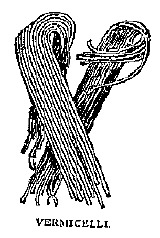 VERMICELLI. — This is a preparation of Italian origin, and is made in the same way as macaroni, only the yolks of eggs, sugar, saffron, and cheese, are added to the paste.
¼ lb. *) ≈ 125 g. of vermicelli,
2 quarts *) ≈ 2 l. of clear gravy stock, No. 169.
Mode. — Put the vermicelli in the soup, boiling; simmer very gently for ½ an hour, and stir frequently.
Time — ½ an hour.
Average cost, 1s. 3d. per quart.
Seasonable all the year.
Sufficient for 8 persons.
¼ lb. *) ≈ 125 g. of sweet almonds,
¼ lb. *) ≈ 125 g. of cold veal or poultry,
a thick slice of stale bread,
a piece of fresh lemon-peel,
1 blade of mace, pounded,
¾ pint *) ≈ 375 ml. of cream,
the yolks of 2 hard-boiled eggs,
2 quarts *) ≈ 2 l. of white stock,
No. 107.
Mode. — Reduce the almonds in a mortar to a paste, with a spoonful of water, and add to them the meat, which should be previously pounded with the bread. Beat all together, and add the lemon-peel, very finely chopped, and the mace. Pour the boiling stock on the whole, and simmer for an hour. Rub the eggs in the cream, put in the soup, bring it to a boil, and serve immediately.
Time. — 1½ hour.
Average cost, 1s. 6d. per quart.
Seasonable all the year.
Sufficient for 8 persons.
Note. — A more economical white soup may be made by using common veal stock, and thickening with rice, flour, and milk. Vermicelli should be served with it.
An ox-cheek, any pieces of trimmings of beef, which may be bought very cheaply (say 4 lbs. *) ≈ 2 kg.),
a few bones,
any pot-liquor the larder may furnish,
¼ peck *) ≈ 2.25 l. of onions,
6 leeks,
a large bunch of herbs,
½ lb. *) ≈ 250 g. of celery (the outside pieces, or green tops, do very well);
½ lb. *) ≈ 250 g. of carrots,
½ lb. *) ≈ 250 g. of turnips,
½ lb. *) ≈ 250 g. of coarse brown sugar,
½ a pint *) ≈ ¼ l. of beer,
4 lbs. *) ≈ 2 kg. of common rice, or pearl barley;
½ lb. *) ≈ ¼ kg. of salt,
1 oz. *) ≈ 30 g. of black pepper,
a few raspings,
10 gallons *) ≈ 40 l. of water.
Mode. — Cut up the meat in small pieces, break the bones, put them in a copper, with the 10 gallons of water, and stew for ½ an hour. Cut up the vegetables, put them in with the sugar and beer, and boil for 4 hours. Two hours before the soup is wanted, add the rice and raspings, and keep stirring till it is well mixed in the soup, which simmer gently. If the liquor reduces too much, fill up with water.
Time. — 6½ hours.
Average cost, 1½ d. per quart.
Note. — The above recipe was used in the winter of 1858 by the Editress, who made, each week, in her copper, 8 or 9 gallons of this soup, for distribution amongst about a dozen families of the village near which she lives. The cost, as will be seen, was not great; but she has reason to believe that the soup was very much liked, and gave to the members of those families, a dish of warm, comforting food, in place of the cold meat and piece of bread which form, with too many cottagers, their usual meal, when, with a little more knowledge of the "cooking." art, they might have, for less expense, a warm dish, every day.